
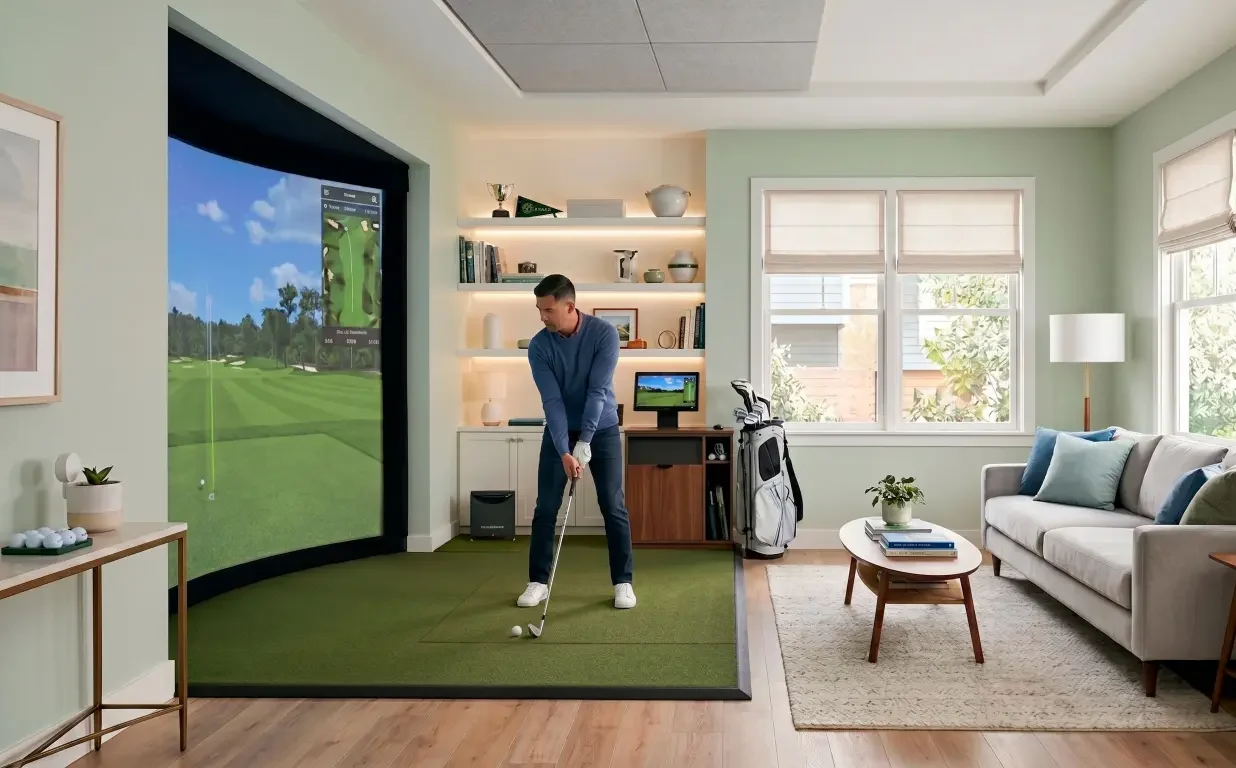
You’re adding a golf simulator to elevate the member experience—but it’s going in close to dining or lounge areas.
On paper, it’s a strong upgrade. More engagement, more time on-site, more reasons for members to visit. But once installation begins, a different concern starts to surface. What happens when the sound of repeated ball strikes carries into a quiet dining room? What happens when vibration travels through the structure and shows up as a dull, constant thump next door?
This is where golf simulator noise reduction becomes less about equipment and more about planning.
The difference between a successful installation and a source of ongoing complaints often comes down to understanding where noise actually comes from—and addressing it before construction begins.
Why Golf Simulator Noise Becomes a Problem in Shared Spaces
A golf simulator has a certain energy to it. The sound of impact, the movement, the interaction—it all contributes to the experience. In a dedicated room, that energy feels contained and appropriate.
But when the simulator is placed near dining or lounge areas, the context changes completely.
What feels like excitement in one room can feel like disruption in another. A steady rhythm of ball strikes may cut through conversations. Low-frequency vibration may travel farther than expected. Even moderate sound levels can become noticeable when they repeat consistently over time.
The challenge is not just volume. It’s proximity, repetition, and how sound behaves within the building. In shared environments, the threshold for what is “acceptable” noise is much lower, especially in spaces designed for comfort, conversation, or relaxation.
That is why golf simulator noise reduction needs to be addressed as part of the initial design—not as a fix after complaints begin.
The Real Sources of Simulator Noise (Not Just What You Hear)
When people think about simulator noise, they often imagine the sound of the ball hitting the screen. That is part of it—but it is only one piece of a larger system.
Understanding the different types of noise helps clarify why some solutions work and others fall short.
Impact noise from club and ball contact
This is the most immediate and recognizable source. Each swing produces a sharp, high-energy sound when the club strikes the ball and the ball hits the screen or enclosure.
In many cases, impact noise is a major contributor to perceived disturbance, especially when swings happen frequently. It is not just loud—it is repetitive and attention-grabbing.
Airborne sound from speakers and ball strike
Airborne sound travels through the air and into adjacent spaces through openings, shared walls, or ceiling cavities.
This includes audio from the simulator system itself, as well as the sound of impact. Airborne sound is what most people try to treat with acoustic panels or soft finishes—but that only addresses part of the problem.
Structural vibration traveling through floors and walls
This is often the most overlooked factor.
When a ball strikes the screen or a player shifts weight during a swing, energy can transfer into the structure of the building. That vibration may travel through floors, framing, and connected surfaces, showing up as a dull thud or resonance in adjacent rooms.
Sound you hear is only part of the equation. Sound you feel—or that travels through the structure—can be just as disruptive, even if it is less obvious at first.
Why Basic Acoustic Panels Don’t Solve the Problem
A common first instinct is to add acoustic panels to the walls.
Panels can help—but not in the way many people expect.
Acoustic panels are designed to absorb sound within a room. They reduce echo and improve clarity inside the simulator space. They can make the room feel quieter and more controlled for the person using it.
What they do not typically do is stop sound from leaving the room.
This is the difference between absorption and isolation. Absorption improves the internal acoustic environment. Isolation prevents sound from traveling to other areas. Most noise complaints in shared spaces are related to isolation, not echo.
This is why installations that rely only on soft finishes often fall short. The room may sound better inside, but adjacent spaces still experience the same disturbance.
For a simulator near a dining or lounge area, addressing transmission—not just reflection—is the critical step.
Diagnosing Your Risk Before Installation
Before selecting materials or solutions, it helps to understand how exposed your project is to noise issues.
Several factors increase risk:
Distance to adjacent spaces matters. A simulator directly next to a dining area has a very different profile than one separated by storage, hallways, or buffer zones.
Shared construction elements matter. Walls, ceilings, and floors that connect directly to other spaces can carry both airborne sound and vibration.
Building materials matter. Some structures transmit sound more easily than others, especially when there is continuous framing or minimal separation between rooms.
Usage patterns matter. A simulator used occasionally creates a different experience than one used continuously during peak hours.
Noise becomes noticeable when it can be detected. It becomes disruptive when it interferes with the intended use of the adjacent space. In a lounge or dining environment, that threshold is relatively low.
Understanding where your project sits on that spectrum helps prioritize the right level of intervention.
The Most Effective Ways to Reduce Golf Simulator Noise
Effective golf simulator noise reduction is not a single solution. It is a combination of strategies that address different types of sound at different points.
Controlling impact at the source (mats, enclosures)
The first opportunity to reduce noise is at the point of impact.
Certain materials and construction approaches can help absorb or soften the energy generated by the club and ball. This does not eliminate sound entirely, but it can reduce the intensity and sharpness of each strike.
The goal is to manage energy before it spreads.
Isolating the room (wall assemblies, decoupling)
Isolation focuses on preventing sound from leaving the simulator room.
This may involve wall assemblies designed to limit sound transmission, as well as construction techniques that reduce direct connections between the simulator space and adjacent areas. Decoupling—separating structural elements so they do not transfer vibration as easily—is often part of this approach.
The specifics will vary depending on the building, but the principle is consistent: reduce the pathways that allow sound to travel.
Managing vibration (floor treatments, structural breaks)
Vibration requires its own attention.
Because it can move through the structure, addressing it often involves interrupting the connection between the simulator and the building. Floor treatments or structural considerations may help reduce how much energy transfers into surrounding spaces.
In many cases, vibration can travel through connected structures, which is why treating only visible surfaces may not be enough.
A complete approach considers all three layers: impact, airborne sound, and vibration.
Designing for Shared Environments (Dining, Lounge, Clubhouse)
When a simulator is placed near dining or lounge areas, the goal is not to eliminate energy—it is to manage it so it feels appropriate across the entire facility.
Physical solutions play a major role, but operational decisions matter too.
Scheduling can help balance usage patterns, especially during peak dining hours. Placement decisions—such as using buffer zones or transitional spaces—can reduce direct exposure. Expectations also matter. Members may accept a certain level of activity, but not if it disrupts conversation or comfort.
The most successful installations consider both the technical and human side of the experience.
A simulator should feel like an enhancement, not an intrusion.
Common Mistakes That Lead to Complaints Later
Most noise-related issues are not caused by a single bad decision. They are the result of a few predictable oversights.
One of the most common is treating acoustics as an afterthought. By the time complaints appear, options become more limited and more expensive.
Another is over-relying on finishes. Adding panels or soft materials can improve how a room feels internally, but it rarely solves transmission issues on its own.
Ignoring vibration paths is another frequent problem. Because vibration is less visible, it is often not addressed until it becomes noticeable elsewhere in the building.
There is also an assumption that commercial spaces can tolerate more noise. In practice, expectations in dining and lounge environments are often higher, not lower.
If you’re planning a golf simulator near shared spaces, the right time to address noise is before construction begins.
A well-designed system balances performance with comfort across the entire facility.
Book a free consultation to plan a simulator space that enhances your club—without creating unintended disruptions.
How to Validate Your Plan Before You Build
Before moving forward, it is worth taking a step back and asking a few practical questions.
Does the plan address all three types of noise—impact, airborne, and vibration—or only one?
Are there clear strategies for limiting sound transmission, not just improving the internal acoustics of the room?
Has the relationship between the simulator and adjacent spaces been considered realistically?
Is the solution based on how the space will actually be used, not just how it looks on a plan?
It can also help to understand what a thoughtful design process should include. That typically means coordination between AV design, construction considerations, and acoustic planning—not isolated decisions made at different stages.
A comprehensive approach tends to feel more cohesive. A reactive approach often leads to adjustments later.
What to Do Next If You’re Planning a Simulator Near Shared Spaces
If your simulator is going near dining or lounge areas, the most valuable step is to address acoustics early.
Start by clarifying where the simulator will sit in relation to other spaces. Then consider how sound might travel, not just where it originates. Coordinate with both AV and construction teams so decisions about materials, layout, and system design support each other.
This is also the point where many facilities choose to bring in a professional integrator. Not because the problem is unsolvable, but because the cost of getting it wrong is higher than the cost of planning it correctly.
Early-stage planning helps reduce the need for later adjustments. It also helps ensure the simulator delivers what it is meant to deliver: a better experience for members, without unintended tradeoffs elsewhere in the club.
If you’re planning a golf simulator near shared spaces, the right time to address noise is before construction begins.
A well-designed system balances performance with comfort across the entire facility.
Book a free consultation to plan a simulator space that enhances your club—without creating unintended disruptions.
Frequently Asked Questions
How loud is a golf simulator room?
A golf simulator room can vary in perceived loudness depending on impact noise, room construction, and frequency of use. Even moderate sound levels can become noticeable when repeated consistently, especially in nearby quiet areas.
What causes the most noise in a golf simulator setup?
Impact noise from the club and ball is often a major contributor, along with airborne sound and structural vibration that can travel through connected building elements.
Do acoustic panels reduce simulator noise effectively?
Acoustic panels can improve sound within the room by reducing echo, but they typically do not prevent sound from traveling to adjacent spaces. They are part of a solution, not a complete fix.
How do you reduce vibration from a golf simulator?
Reducing vibration usually involves addressing how energy transfers into the structure, often through floor treatments or construction techniques that limit direct connections between spaces.
Can a golf simulator be installed near a restaurant or lounge?
Yes, but it requires careful planning. Without proper acoustic and structural considerations, noise and vibration can affect the experience in nearby areas.
What flooring helps reduce golf simulator noise?
Certain flooring approaches may help reduce vibration and impact transfer, but the effectiveness depends on how they are integrated into the overall system and structure.
If you’re planning a golf simulator near shared spaces, the right time to address noise is before construction begins.
A well-designed system balances performance with comfort across the entire facility.
Book a free consultation to plan a simulator space that enhances your club—without creating unintended disruptions.
Request an acoustic assessment to understand how sound and vibration may affect adjacent areas before installation begins.
RELATED LINK: