
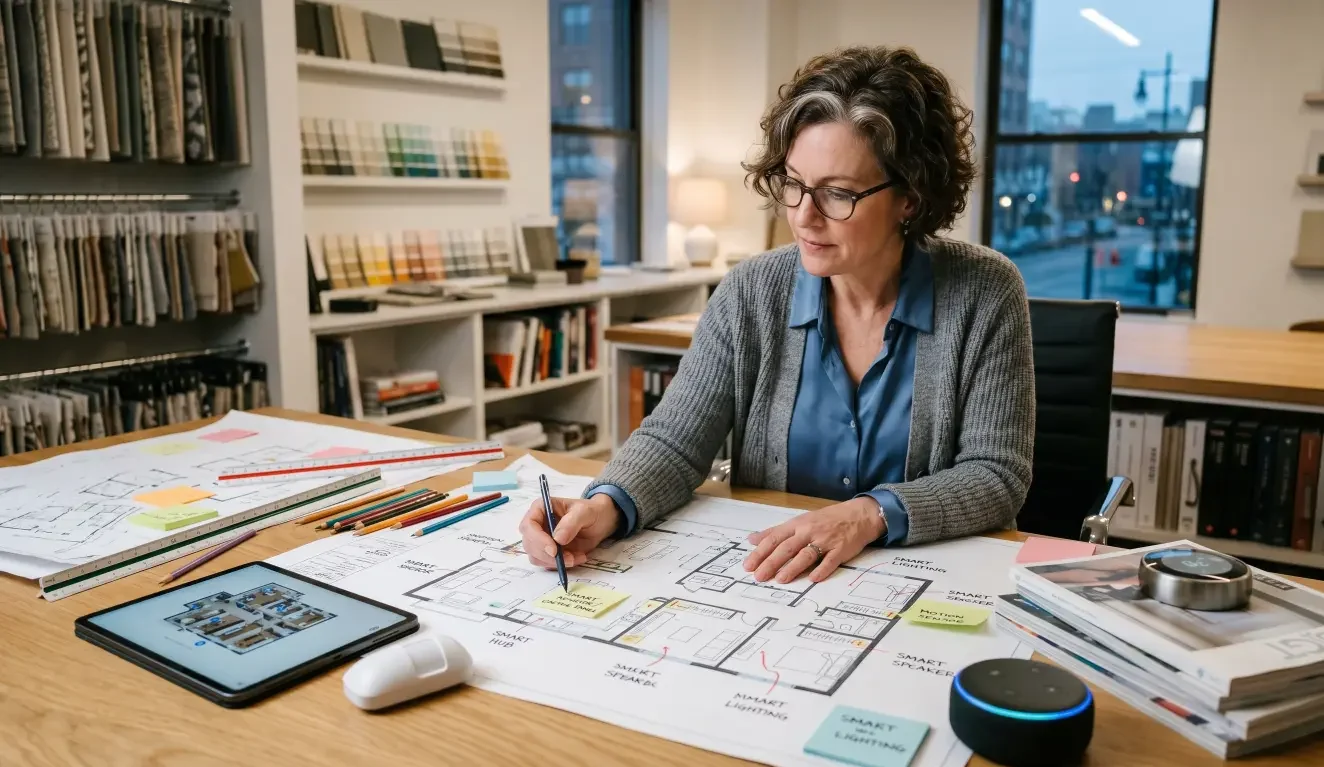
You’ve finalized finishes, elevations, and furniture layouts—and then the conversation shifts to smart home technology.
Suddenly, there are questions that were not part of the original design review. Where should the keypads go? Will ceiling speakers interrupt a clean plane? Does the TV now need to sit on the one wall you worked hard to keep quiet? What happens to the window treatment plan when motorized shades enter the conversation late?
This is a familiar moment in high-end residential projects. The design is largely resolved, the visual language is established, and technology arrives just late enough to feel disruptive. In many cases, coordinating smart home systems earlier helps avoid those compromises. But even when that did not happen, the project does not have to slide into a series of visible concessions. With the right coordination, technology can still support the design intent rather than competing with it.
Learn how to coordinate smart home with interior design to avoid visible compromises, improve planning, and align technology.
The Moment Technology Enters Too Late
The late-stage technology conversation usually starts innocently.
A client decides they want more control over lighting and shades. A builder asks for device locations. An AV integrator is brought in after millwork is already drawn and wall treatments are selected. On paper, these may sound like manageable additions. In practice, they touch some of the most visually sensitive parts of the project.
Walls that were meant to stay clean now need a place for controls. Ceilings that were carefully aligned around lighting and architectural lines may need speakers. A room with a strong focal point suddenly has to accommodate a screen. Window details that were designed around fabric treatments now need room for shade hardware, pockets, wiring, or access.
The problem is not that technology was added. It is that the project has already made key visual decisions without fully accounting for where that technology will live.
For an interior designer, that can create a frustrating shift in the work. Instead of refining the final experience of the space, you are protecting it from last-minute intrusions. The focus moves from composition to accommodation.
That is why learning how to coordinate smart home with interior design matters so much on design-forward projects. The issue is rarely technology alone. It is what happens when functional requirements show up after the aesthetic framework is already fixed.
What Actually Starts to Break When Tech Isn’t Coordinated Early
When smart home planning comes in late, the damage is rarely dramatic at first. It shows up as a series of small misalignments that gradually weaken the overall result.
One of the first friction points is keypad placement. A keypad that lands at the wrong height, too close to a casing, or off the visual rhythm of a wall can feel minor in isolation. But on a carefully considered elevation, it reads immediately. A clean limestone wall with a precisely centered sconce now has an extra control plate that was never part of the composition. A hallway with tailored trim lines suddenly has a bank of controls floating without alignment.
Speakers create a different kind of problem. They often get treated as technical items rather than visual elements, which is exactly why they become noticeable. A ceiling plan may be elegant until circular grilles appear without regard to lighting layout, beams, or sightlines. In some cases, finish-matching may help them recede. In other cases, the issue is not color alone but spacing and placement.
TVs are another common afterthought. Without an early strategy, the screen tends to end up where there is leftover wall space rather than where it makes sense for the room. That can undermine a focal wall, interrupt symmetry, or force awkward furniture decisions. Even when the client wants a hidden TV solution, concealment options may be limited once millwork, power locations, and room layout are already set.
Shade integration often becomes visible later than expected. What seemed like a straightforward decision to add motorized shades may begin affecting pocket dimensions, treatment details, stack space, or the relationship between hardware and finished trim. If that coordination happens too late, the result can feel layered rather than integrated.
None of these issues are necessarily catastrophic on their own. The real problem is accumulation. Each late adjustment asks the design to absorb one more compromise. Eventually, the room still functions—but it may no longer feel as intentional as it was meant to.
A Walkthrough of a Typical Late-Stage Project (And How to Recover It)
Late-stage coordination is easier to manage when you stop treating it like a technical add-on and start reviewing the project through a second lens: what the technology requires visually, spatially, and operationally.
Step 1: Reviewing the Finished Design Through a Technology Lens
At this stage, the goal is not to redesign the house. It is to identify where the current design and the technology plan are likely to conflict.
Start with the most sensitive surfaces: primary walls, entry sequences, ceiling planes, focal elevations, and custom millwork. Then review the spaces where control, visibility, and concealment matter most—typically the main living areas, primary suite, media rooms, and large openings with window treatments.
Look closely at wall composition. Where would a keypad naturally fall? Does it land on a quiet stretch of wall or in the middle of a carefully balanced composition? Is it too close to a switch, thermostat, art light, or casing? Does the control location support how someone actually moves through the space?
Then move to the ceiling. If speakers are being added, do they compete with downlights, linear fixtures, air devices, or architectural rhythm? Even when speakers can blend visually, they should still feel deliberately placed rather than scattered.
Next, review millwork and furniture layouts. If a TV is part of the room, where was it assumed to go? Was it intentionally integrated, or simply deferred? If the answer is unclear, that uncertainty usually becomes visible later.
Finally, revisit windows. If shades were not part of the original design package, the question is no longer just whether they can be added. It is whether they can be added in a way that respects the treatment design, trim conditions, and proportions of the opening.
This review is often where the real project story becomes clear. The issue is not that the design is wrong. It is that no one has yet mapped the technology requirements onto the visual decisions.
Step 2: Prioritizing What Must Be Seen vs Hidden
One of the biggest mistakes on late-stage projects is assuming that every piece of technology should disappear.
In reality, not everything can vanish gracefully, and not everything should. The better question is which elements need to recede and which ones should be handled with enough restraint that they can remain visible without feeling intrusive.
Controls are a good example. Some designers initially want to eliminate visible keypads altogether, only to discover that the alternative is reduced usability or a clutter of separate controls elsewhere. In many situations, a well-placed, minimal keypad is a cleaner design move than forcing every function into an app or scattering control points inconsistently.
The same is true for speakers. In some rooms, concealment strategies may make sense. In others, a clean grille placed with discipline can be more elegant than an overcomplicated attempt to hide sound sources in ways that distort the room or limit performance.
TVs require similar judgment. Sometimes concealment is worth pursuing. Sometimes the stronger move is to integrate the screen into the architecture honestly—flush, framed, or balanced within millwork—rather than pretending it is not there.
The late-stage recovery process works best when you decide, room by room, what should visually disappear, what should visually soften, and what should be treated as part of the composition.
Step 3: Adjusting Without Redesigning Everything
Once the conflict points are identified and the visibility priorities are clear, the project usually needs targeted adjustments—not a full reset.
A keypad may shift a few inches to align with a casing line or millwork edge. That sounds minor, but those small alignment decisions often determine whether the control feels intentional or accidental.
A speaker grille finish may be revised to better suit the ceiling or wall surface. In some cases, the placement may matter even more than the finish. Tightening spacing and coordinating with other ceiling elements can make a noticeable difference.
A TV strategy might evolve from “find a wall for it” to “integrate it with the architecture we already have.” That could mean adjusting millwork proportions, rethinking the focal sequence of the room, or selecting a placement that respects the visual weight of the space.
Shade integration may require a more careful conversation with the window treatment plan. The question becomes whether the hardware can be coordinated cleanly, whether a pocket detail needs refinement, or whether treatment dimensions should shift slightly to accommodate a more cohesive result.
The key point is that late-stage coordination is still design work. It is not merely problem-solving after the fact. When handled well, these adjustments preserve the original intent rather than diluting it.
Key Design Decisions That Should Happen Earlier (But Can Still Be Refined)
Some design decisions carry more weight than others once smart home technology is involved. Even if the project is already underway, these are the places where thoughtful refinement can still make a meaningful difference.
Keypad placement is one of them. It affects both how the home feels to use and how the walls read visually. In luxury spaces, a keypad should not be treated like an afterthought tucked wherever there is room. It should align with how someone enters the space, how the wall is composed, and how the eye travels across trim, art, and architectural lines. Height matters. Proximity matters. Whether the keypad sits alone or in a cluster matters.
Speaker grilles deserve the same level of visual attention as any other surface interruption. Matching speaker grilles to finishes may be possible in some situations, but finish alone is not the whole answer. The designer should also look at symmetry, spacing, and whether the speaker layout works with the ceiling plan rather than against it. A speaker that blends in color but breaks the logic of the room still reads as a compromise.
TV integration needs a defined strategy. Flush integration, framed integration, and concealed solutions each create a different design outcome. The right choice depends on the architecture, the purpose of the room, and the client’s priorities. What matters most is that the TV is treated as a planned element, not as an orphaned screen placed after every other decision has been made.
Shade planning often benefits from earlier coordination than many teams expect. Once motorized shades enter the picture, the discussion is no longer only about fabric or privacy. It includes mounting conditions, pocket details, access, stack considerations, and how the shades relate to drapery or other window treatments. That coordination can still be refined later, but it becomes more constrained once construction details are in motion.
A related conversation—often overlooked until very late—is lighting scenes. Even when fixture placement is already resolved, the way lighting is grouped and controlled affects the design experience of a room. A beautiful space can lose some of its intended mood if the control logic does not support the way the room is meant to feel in the morning, evening, during entertaining, or in quiet daily use.
These are not small technical decisions. They are design decisions with technical consequences.
Hiding Everything Isn’t Always the Best Design Choice
There is a common assumption in high-end projects that the best technology is invisible technology.
Sometimes that is true. But not always.
When “hidden” becomes the only goal, teams can end up making choices that look clever on paper but feel awkward in real use. A control system that is too concealed may become less intuitive. A TV that disappears perfectly may also compromise furniture layout or viewing comfort. A speaker strategy aimed solely at invisibility may force less coherent placement.
In many situations, the cleaner design move is not total concealment. It is disciplined visibility.
That might mean using a refined keypad in a deliberate location rather than avoiding controls until the room ends up with scattered interfaces. It might mean accepting a well-integrated screen on a secondary focal wall rather than overengineering concealment into millwork that was not designed for it. It might mean allowing a speaker grille to exist quietly within a well-composed ceiling rather than forcing it into a worse location.
Interior designers already make these judgments with other functional elements. Return grilles, outlets, access panels, and hardware are rarely invisible in an absolute sense. They are successful when they are integrated with enough discipline that they do not fight the room.
Smart home technology benefits from the same thinking. The goal is not to erase every sign of function. It is to decide what should disappear, what should soften, and what can remain visible without interrupting the design language.
Common Mistakes That Create Visible Compromises
When a project starts absorbing late-stage technology decisions, a few predictable mistakes tend to create the most visible compromises.
One is ignoring control interfaces entirely. In an effort to keep walls clean, teams sometimes avoid discussing keypads until the very end. The result is rarely a cleaner project. More often, it leads to awkward control placement, inconsistent user experience, or a room that relies on workarounds rather than clear, intuitive operation.
Another is treating speakers as purely technical components. Once that happens, they get placed where they work mechanically but not where they make sense visually. Ceiling symmetry, fixture alignment, and sightlines all start to suffer.
TV placement is often deferred longer than it should be. Designers may hope the room can stay visually pure until someone finally asks where the screen goes. By then, the options may be narrower than they appear. The TV ends up controlling the room because it was not part of the conversation early enough.
Shade coordination is also commonly underestimated. A designer may have a strong window treatment concept, but if motorized shades are introduced without coordination, details that seemed settled can suddenly need revision. The disruption may not look dramatic on a drawing set, but it can be noticeable in the finished room.
A final mistake is assuming the integrator can solve everything independently once they are brought in. A technology partner can help resolve many late-stage issues, but the best outcomes still require design collaboration. Without that, the project can become a series of technical solutions layered onto a design rather than integrated into it.
How to Coordinate Smart Home with Interior Design—Even Late
If the project is already underway, the most useful next step is not a broad reset. It is a focused coordination pass with both design intent and technical requirements on the table.
Bring the integrator into the conversation immediately, not after another round of decisions has already been made. The earlier that happens within the remaining timeline, the more options tend to remain available.
Then review drawings together. That includes elevations, reflected ceiling plans, millwork details, and key room layouts. The point is not simply to confirm device counts. It is to understand how technology interacts with finishes, alignments, and the experience of moving through the space.
At this stage, it helps to align on finish palettes and hardware selections as well. If control interfaces, grilles, screens, and shade details are being discussed in isolation, they are more likely to feel disconnected in the final result. When they are reviewed against the broader material palette, it becomes easier to make cleaner decisions.
Revisit key elevations before construction proceeds too far. A few thoughtful adjustments at this point can prevent a larger compromise later. Sometimes the fix is a location shift. Sometimes it is a finish revision. Sometimes it is a clearer decision about what the room should prioritize visually.
Most importantly, keep the conversation anchored in design outcomes, not just technical allowances. The right question is not “Can this go here?” It is “What happens to the room if it does?”
That shift changes the quality of the coordination immediately.
What to Look for in a Technology Partner (From a Designer’s Perspective)
Not every technology partner works well in a design-led process.
From a designer’s perspective, the most valuable partner is one who can discuss technology in terms of architecture, finishes, sightlines, and user experience—not only equipment and wiring. They should be able to understand why a wall composition matters, why a millwork reveal changes a control location, or why a ceiling layout cannot simply absorb one more visible element without consequence.
Flexibility matters too, especially on late-stage projects. Once the design is mostly complete, the work becomes less about ideal technical conditions and more about adapting intelligently to what already exists. A strong partner can navigate those constraints without treating the design as the obstacle.
Experience coordinating with designers and architects is also important. The best collaboration tends to happen when the technology partner understands that they are joining a larger design process, not operating beside it. That usually shows up in the way they review plans, communicate options, and frame tradeoffs.
For designers, this is often the difference between a vendor and a collaborator.
A collaborator helps preserve intent. They understand that a keypad location is not just a technical coordinate. A speaker is not just a coverage point. A shade detail is not just a motor specification. Each decision is part of a finished environment the client will see, use, and judge as a whole.
A More Collaborative Way to Approach Future Projects
Late-stage coordination can usually be improved. Future projects can be approached differently.
The most effective shift is simple: position technology coordination as part of the design process, not as something that follows it. That does not mean technology needs to dominate early conversations. It means the right questions are raised before the design becomes too rigid to absorb them gracefully.
For an interior designer, that can be a design advantage rather than an administrative burden. Early coordination often gives you more control over where tech lives, how it looks, and how it supports the experience you want the space to create. It allows you to protect quiet walls, manage ceiling composition, guide TV placement, and align shade planning with treatment design before those decisions become reactive.
It also creates a better experience for the client. Instead of seeing technology as an intrusion that shows up late, they experience it as part of a cohesive environment that feels both thoughtful and livable.
That is usually the best kind of smart home result: not the one that announces itself, but the one that feels considered from the start.
Start the Conversation Before the Next Compromise
If technology is starting to impact your design decisions—or you want to avoid that on your next project—we can help you coordinate both from the start.
We work alongside designers to align smart home systems with the overall vision, not against it.
Schedule a free consultation to explore how technology can support your design, not compete with it.
FAQ
When should smart home planning start in a design project?
Ideally, smart home planning begins before key visual decisions are fully locked in. That gives the design team more flexibility around keypad placement, ceiling coordination, TV strategy, and shade integration. If the project is already further along, it is still worth reviewing the design through a technology lens as soon as possible.
Where should keypads be placed in a luxury home?
Keypads should be placed where they support both the way the home is used and the way the walls are composed. In luxury interiors, that usually means considering height, alignment with trim or millwork, proximity to casings, and how visible the control will feel in the overall elevation. The best location is usually the one that feels intentional both functionally and visually.
Can speakers be hidden without affecting design?
In some cases, speakers can be made less visually prominent through thoughtful placement and finish coordination. But concealment is not always the only goal. A well-integrated visible grille can sometimes create a cleaner result than forcing speakers into less appropriate locations. The right approach depends on the room, ceiling plan, and design priorities.
How do you integrate TVs into high-end interiors?
High-end TV integration usually starts with a clear decision about the role the screen should play in the room. It may be flush with the architecture, framed within millwork, or concealed depending on the space and client priorities. What matters most is treating the TV as part of the design strategy rather than placing it after everything else is resolved.
How do motorized shades work with window treatments?
Motorized shades often work best when they are coordinated with window treatments early enough to account for mounting conditions, pocket details, stack space, and access. Even on later-stage projects, they can often still be integrated more cleanly when the treatment design and shade requirements are reviewed together instead of separately.
What happens if smart home tech is added too late?
When smart home technology is introduced too late, the project may have fewer clean options for controls, speakers, TVs, and shades. That can lead to visible compromises, last-minute revisions, or design decisions that feel more reactive than intentional. A focused coordination review can often improve the outcome, even if the design is already well underway.
Book a Free Consultation
If technology is starting to impact your design decisions—or you want to avoid that on your next project—we can help you coordinate both from the start. We work alongside designers to align smart home systems with the overall vision, not against it. Schedule a free consultation to explore how technology can support your design, not compete with it.
RELATED LINKS:
Interior Design Standards / Best Practices