
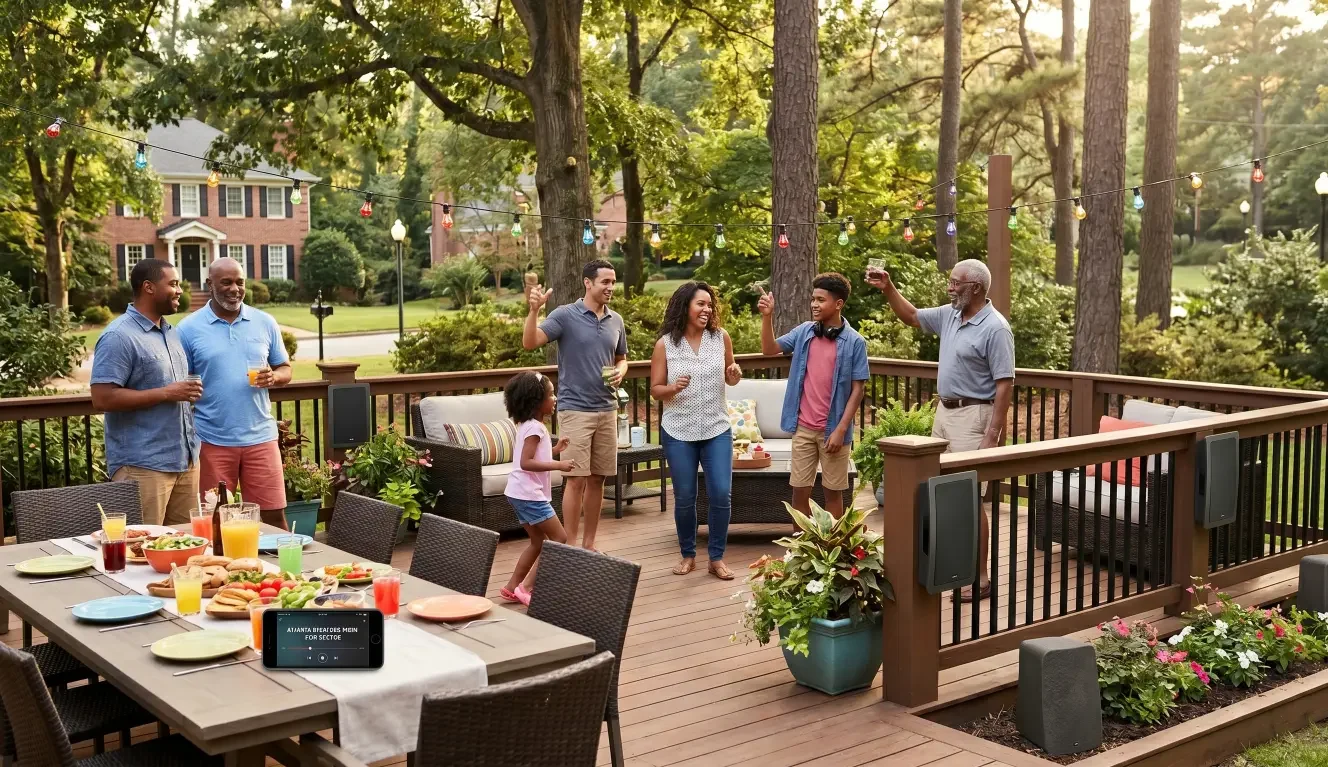
You turn on music for a backyard gathering, and everything feels fine from your patio. Then later, maybe the next morning, you hear that the sound carried farther than you realized.
That is a common problem in close-lot neighborhoods. Outdoor audio is not just about getting enough volume to hear music by the pool, on the patio, or near the outdoor kitchen. It is also about keeping that sound where you want it.
When homeowners search for ways to create outdoor audio not bothering neighbors, they often assume the answer is simply turning the volume down or buying a different speaker. In reality, the bigger issue is usually containment.
A well-designed outdoor audio system is less about blasting sound across a backyard and more about shaping coverage around the people actually using the space. Direction, speaker placement, zone control, and bass management all matter. If those elements are ignored, even a nice-looking system can create friction with the people living just beyond your fence line.
The good news is that this problem is often fixable. And in many cases, you do not need to start over completely. You just need to understand why the sound is escaping in the first place.
The Real Problem: Outdoor Audio Isn’t Contained by Default
Indoor sound behaves differently because rooms naturally contain it. Walls, ceilings, doors, rugs, upholstery, and other surfaces all help keep sound within a defined space. Outdoors, those boundaries largely disappear.
That means sound often travels farther than people expect. There is less structure to absorb it, fewer surfaces to control it, and more open air for it to move through. A backyard may feel private visually, especially with landscaping or fencing, but that does not automatically make it acoustically contained.
This becomes more noticeable in neighborhoods where homes sit close together. A speaker mounted under a covered patio may sound balanced to the person standing nearby, but the same system can carry into a neighbor’s side yard, upstairs bedroom, or adjoining outdoor space in a way that feels much louder from their perspective.
Reflections can also play a role. Hard surfaces like brick, stone, stucco, glass, and concrete can bounce sound back into the yard or outward beyond it. Covered patios and outdoor kitchens may improve listening in one area while unintentionally projecting sound into another. Even the orientation of the yard matters. A system firing toward a property line behaves very differently than one aimed inward toward the home and primary seating area.
This is why outdoor audio not bothering neighbors requires actual design. Without a plan for containment, the system may default to the easiest path for sound to travel, not the most respectful one.
Why Your Current Setup Is Likely Causing Complaints
When neighbors complain about outdoor audio, the issue is usually not that the system exists. It is that the system was set up for convenience instead of control.
One common problem is speaker direction. Many outdoor speakers are mounted where they physically fit, not where they acoustically make the most sense. If they are aimed outward across the yard, toward the fence, or beyond the listening zone, the sound does exactly what those angles tell it to do: it keeps going.
Another frequent issue is using too few speakers at too much volume. Homeowners often assume a pair of speakers can cover a large backyard if they just turn them up enough. The result is uneven sound nearby and excess sound farther away. The people closest to the speakers may find the music harsh, while the people outside the intended zone still hear it clearly.
A lack of audio zones creates a different kind of problem. If the pool area, dining area, and patio all run off one volume level, the system usually has to be set for the farthest listener. That often means the areas closer to the speakers are louder than necessary. Proper zoning can help manage this by giving each area its own level of control rather than treating the whole backyard like one open audio field.
Then there is bass. Even homeowners who are careful about general volume often overlook low frequencies. Bass tends to feel more atmospheric inside the yard, but beyond the property line it can become the most annoying part of the system. It is less about hearing every lyric and more about feeling an ongoing thump or rumble that never quite disappears.
If your setup is causing complaints, it does not necessarily mean the equipment is bad. It often means the sound is spreading in ways the original layout never accounted for.
Diagnosis: Where Sound Is Escaping Your Yard
Before you try to solve the problem, it helps to diagnose where the sound is actually escaping. In most backyards, the issue comes down to four things: direction, coverage, boundaries, and low frequencies.
Direction — Where Your Speakers Are Pointing
Direction is usually the first thing to check because it is one of the biggest reasons outdoor sound spills beyond the property.
If speakers are pointing outward toward the edge of the yard, they are effectively projecting sound toward the neighbor’s side. Even a slight change in angle can influence where the strongest part of the audio lands. A speaker that fires across open space behaves very differently from one aimed down and inward toward a seating area.
This is especially important with mounted speakers. When they are installed high on an exterior wall or under an eave, it is easy for them to overshoot the listening area if their tilt and orientation are not carefully considered. The music may feel pleasantly present near the house but still travel much farther than intended.
Directional outdoor speaker placement works best when the sound is aimed at people, not property lines.
Coverage — How Evenly Sound Is Distributed
Coverage is about whether the audio is spread evenly across the area where people actually gather.
Poor coverage leads to a predictable mistake: turning the system up so people at the far edge of the space can still hear it. That tends to make the closer zones much louder than they need to be, and it increases spill far beyond the intended listening area.
More even coverage often comes from distributing sound across multiple points rather than relying on one or two loud sources. In many cases, this approach allows the sound to feel full and immersive where you want it, while keeping the overall output lower.
If you are wondering how to keep outdoor speakers from bothering neighbors, this is one of the most important mindset shifts. The goal is not maximum reach. It is controlled coverage.
Boundaries — What Stops (or Doesn’t Stop) Sound
Homeowners often assume fences, shrubs, or visual screening will do more acoustically than they actually do.
A solid wall or structure may help influence how sound behaves, but many common backyard boundaries do not stop much audio at all. Decorative fencing may preserve privacy visually without providing meaningful containment. Landscaping may soften the feel of a property edge, but it does not automatically create an acoustic barrier.
That does not mean boundaries are irrelevant. It means they should not be overestimated. When planning or troubleshooting an outdoor system, it helps to think of the boundary as the place where sound should already be under control, not the place where it will magically stop.
In practical terms, the closer your entertaining area sits to a property line, the more careful the speaker layout needs to be.
Low Frequencies — Why Bass Travels the Farthest
Low frequencies are often the hardest part of outdoor audio to contain.
Higher frequencies tend to feel more directional. Bass behaves differently. Lower frequencies can spread more broadly and feel persistent even when the overall system is not especially loud. That is why a neighbor may not describe the music itself as the issue. They may say they keep hearing or feeling the bass.
This is also why some systems sound fine during a daytime test but become more noticeable later, especially in quieter evening conditions. The bass does not need to be overwhelming inside your yard to feel intrusive outside it.
If you have ever reduced the overall volume and still had concerns about complaints, bass may be the reason.
The Contrarian Reality: Louder Isn’t the Problem—Uncontrolled Sound Is
Most homeowners assume the fix is obvious: just keep the volume lower.
Sometimes that helps. But it is not always the real answer.
A system can be relatively modest in volume and still be irritating if the sound is poorly aimed, unevenly distributed, or heavy in the wrong frequencies. On the other hand, a well-designed system can sometimes feel more enjoyable at lower output because the audio is reaching the listener more directly and more consistently.
This is the contrarian reality of outdoor audio design. The issue is not always “too loud.” It is often “not controlled.”
Think about a patio where two speakers mounted high on the house are trying to cover the pool, outdoor kitchen, and lounge seating all at once. To reach everyone, the system has to push sound across the entire yard. That creates overexposure close to the house and underexposure farther away, which encourages even more volume. Now compare that to a design with better distribution and separate zones. Each area can often be served more appropriately, which may allow the music to feel full without flooding the edges of the property.
That is why outdoor audio zones for a backyard can make such a difference. They give you control over where sound is active and how strong it feels in each part of the space. If nobody is using the far side of the yard, that area does not need to be energized like the main entertaining zone.
Containment is often about precision, not restraint for its own sake.
Design Strategies That Keep Sound Where You Want It
Once you understand how sound is escaping, the next step is designing for containment.
The first strategy is directional placement. Speakers should generally aim toward the primary listening areas, not away from them. That may sound simple, but it changes the entire behavior of the system. When sound is directed inward toward seating, dining, or lounge zones, it tends to feel more intentional and less diffuse. This is one of the most practical ways to approach directional outdoor speaker placement without overcomplicating the design.
The second strategy is using more speakers at lower volume rather than asking one or two speakers to do all the work. In many cases, that creates more even coverage and helps avoid hot spots. The goal is not more gear for its own sake. It is more controlled delivery of sound. A listener should not need to stand in one exact spot to hear the music clearly.
The third strategy is zoning. Outdoor living spaces often serve multiple purposes: dining, swimming, lounging, conversation, maybe even watching a game outside. Treating all of that as one audio field usually reduces control. Zoning can help manage where music plays, how strong it feels, and which areas need sound at any given moment.
The fourth strategy is choosing speaker types designed for contained sound rather than broad, uncontrolled projection. Exact product selection is TBD depending on the property and goals, but the important point is this: the best speaker type for contained sound is usually the one that supports targeted coverage instead of wide spill. Design matters more than marketing labels.
It also helps to think in terms of listening zones rather than equipment locations. The right question is not just “Where can speakers go?” It is “Where do people actually spend time, and how can sound reach them without overshooting the space?”
That approach tends to produce a more comfortable experience inside the yard and a more respectful experience outside it.
Managing Bass Without Killing the Experience
Bass is usually the hardest part of the system to get right in a close-lot neighborhood.
Homeowners often associate bass with richness and impact, especially when entertaining. But outdoors, too much low-frequency energy can travel beyond the space more easily than expected. It can also linger in a way that makes the system feel more intrusive than the volume setting alone would suggest.
That does not mean outdoor spaces need to sound thin or lifeless. It means bass should be handled intentionally.
Placement matters. A bass-heavy element placed too close to a property edge may increase the perception of sound spill. Positioning choices should support the main listening area rather than energizing the outer perimeter. The relationship between hardscape, walls, and reflective surfaces may also influence how bass behaves.
It is also worth considering whether the listening goal truly requires strong bass in every moment. For many backyards, background music during dinner or casual conversation feels better with more restraint. A system that is slightly leaner on the low end may actually sound cleaner outdoors, especially when the goal is ambiance rather than nightclub energy.
If you are trying to figure out how to reduce bass travel outdoors, the answer is usually not one single adjustment. It is a mix of system design, placement, level management, and realistic expectations about how much low-frequency energy the space can comfortably support.
In some cases, less bass does not feel like a compromise. It feels more appropriate to the environment.
Common Mistakes That Make Outdoor Audio Travel Too Far
A few recurring mistakes show up in backyards where sound routinely escapes.
One is mounting speakers high and facing them outward. This often happens because the installation feels visually neat and keeps equipment out of the way. But acoustically, it can send sound farther than intended, especially when the speakers are covering a large open area.
Another mistake is using indoor-style thinking outdoors. Indoors, reflective surfaces and room boundaries help support the listening experience. Outdoors, that same assumption can lead to underestimating how much coverage the system really needs and overestimating how much natural containment the space provides.
Relying on a single source for a large backyard is another common issue. It may seem efficient, but it usually creates uneven listening and encourages higher volume. A bigger yard, or even a modest yard with multiple activity zones, tends to benefit from a more distributed plan.
Ignoring property lines during planning is also a major problem. Homeowners often think first about where speakers will look best or where wiring is easiest. Those details matter, but the property edge should be part of the design conversation from the beginning. A layout that sounds great from the center of the yard may still be the wrong layout if it sends too much energy toward the neighbor’s fence.
And finally, many people assume the answer is simply buying a better speaker. Sometimes equipment changes may help. But without correcting placement, angles, coverage, and zone logic, a more expensive setup can still create the same tension.
How to Fix an Existing Setup Without Starting Over
If your current system is already installed, there are still meaningful ways to improve it.
Start by re-aiming the speakers. Even modest angle changes can help pull sound back toward the listening area instead of pushing it outward. If the speakers are mounted under an eave or on a wall, review whether they are firing across the yard rather than down into the space.
Next, look at control. If the whole yard operates as one zone, consider whether splitting the system would create better flexibility. You may not need the same output everywhere all the time. Being able to lower or mute one section while keeping another active can make the system feel more tailored and less invasive.
Redistributing speakers may also be worthwhile. If one area is carrying too much of the load, adding or repositioning speakers can often improve coverage. This is especially relevant when homeowners are using a pair of speakers to serve multiple functions across a broad outdoor area.
Then review bass management. If complaints seem tied to an ongoing rumble more than obvious volume, the low end may need attention. In some cases, minor tuning or placement changes can improve containment without making the system feel disappointing inside the yard.
And if you are already planning small upgrades, focus on changes that improve control rather than just output. Better containment usually comes from smarter design, not simply more power.
A soft next step here can be useful. If you want to optimize your existing outdoor audio setup, it may help to evaluate the layout before assuming replacement is necessary.
How to Tell If Your System Is Actually Contained
Containment should not be judged only from the center of your patio.
The best test is to experience the system from the places where complaints are most likely to come from. Walk the edges of your property during normal playback. Stand near the fence, side yard, driveway, or any area closest to neighboring homes. Listen not just for music clarity, but for whether the sound still feels present when it no longer needs to.
It also helps to shift perspective. Listen from upstairs windows, from the far end of the yard, or from quieter areas where people might retreat in the evening. If possible, test the system at different times of day. Sound that seems subtle during a busy afternoon can feel more pronounced at night when the neighborhood is quieter.
Another useful check is whether the system remains balanced at lower listening levels. A contained system should still feel satisfying where you want it without requiring the volume to climb just to fill the space.
What you are looking for is not silence at every property edge. That is not always realistic. What you want is sound that feels centered around your outdoor living area rather than projected beyond it. The music should belong to your space, not the whole block.
If it does not, that usually points back to the same core questions: direction, coverage, boundaries, and bass.
Enjoy Your Outdoor Space Without the Tension
If your outdoor audio is starting to create tension—or you want to prevent that from happening—a thoughtful design approach can make all the difference.
We help homeowners create outdoor sound systems that feel immersive inside your space while staying contained beyond it.
Schedule a free consultation to explore how your setup can be refined without compromise.
FAQ
How do I keep outdoor speakers from bothering neighbors?
Start by focusing on containment rather than just volume. Speaker direction, coverage, zoning, and bass management all influence how far sound travels. In many cases, aiming speakers inward, improving distribution, and reducing unnecessary spill near property edges can help.
What type of outdoor speakers are best for contained sound?
The best fit is usually a speaker type that supports targeted coverage rather than broad projection. Exact choices depend on the yard layout and listening goals, but design and placement typically matter more than choosing a product based on name alone.
Why does bass travel farther outdoors?
Lower frequencies tend to spread more broadly and feel more persistent in open spaces. Outdoors, there are fewer boundaries to contain them, which is why bass can remain noticeable even when the rest of the system does not seem especially loud.
How should outdoor speakers be positioned in a backyard?
They should generally be positioned to serve the main listening areas and aimed toward the people using the space. In many cases, that means avoiding high outward-facing placement and instead designing around inward coverage, even distribution, and awareness of nearby property lines.
Do outdoor audio zones help reduce noise complaints?
They can help. Zoning allows different areas of the yard to run at different levels or remain off when not in use. That often improves control and reduces the need to set the whole system louder than necessary.
Can I fix outdoor sound issues without replacing my system?
Often, yes. Re-aiming speakers, adjusting coverage, adding zones, redistributing sound, or refining bass behavior may improve containment without requiring a full replacement. The right fix depends on how the current system is laid out.
Optimize your existing outdoor audio setup
If your outdoor audio is starting to create tension—or you want to prevent that from happening—a thoughtful design approach can make all the difference. We help homeowners create outdoor sound systems that feel immersive inside your space while staying contained beyond it. Schedule a free consultation to explore how your setup can be refined without compromise.
RELATED LINK: