
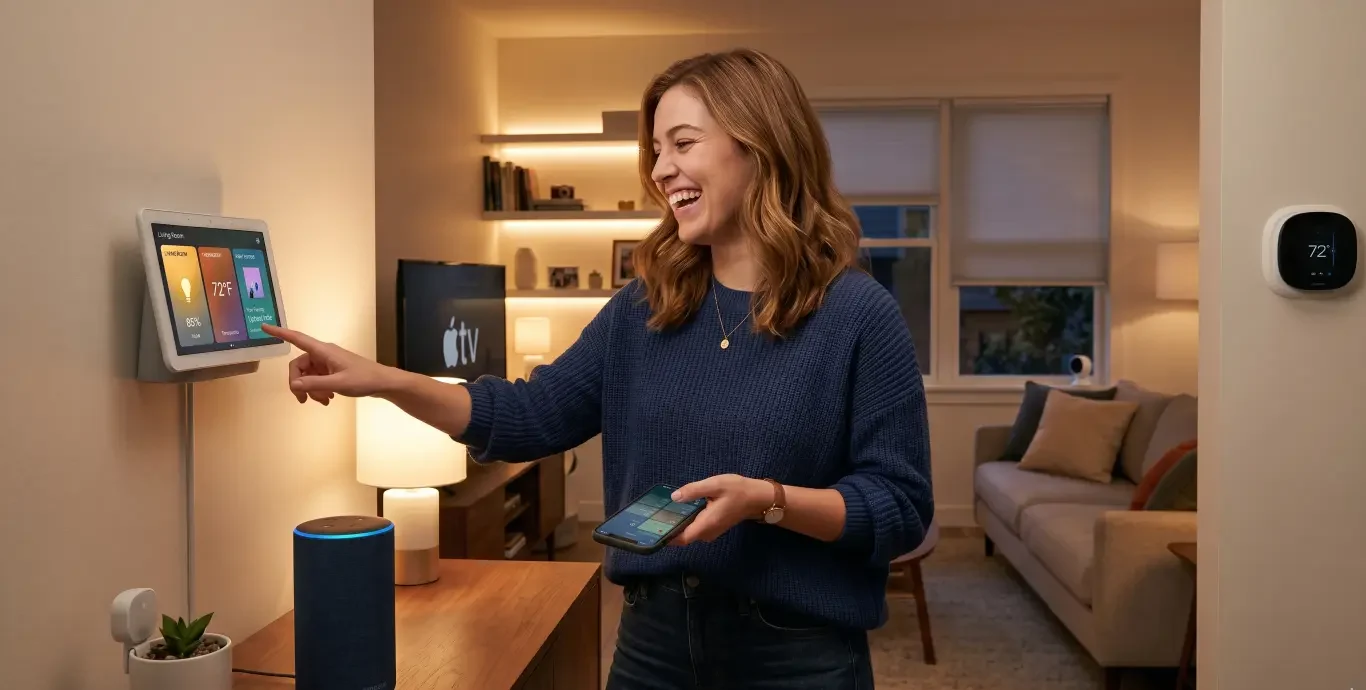
You tried to build a smart home the same way many homeowners do: one device at a time, one app at a time, one “this should be easy” purchase at a time.
At first, it felt exciting. A smart speaker here, a few lights there, maybe a thermostat, a camera, a video doorbell, and a couple of automations that worked well enough to feel promising. But over time, the setup became harder to live with, not easier. Different devices stopped cooperating. Family members got confused. Routines broke. You ended up managing technology instead of enjoying it.
That is usually where smart home regret starts.
If you are rebuilding after a bad DIY setup, or planning a smarter system from the beginning because you do not want to repeat that experience, the goal is not to buy better gadgets. The goal is to design a system that works together, feels simple to use, and still makes sense years from now.
To avoid smart home regret, you need to think less like a shopper and more like a planner.
The Real Problem Isn’t Your Devices—It’s the Lack of a System
Most disappointing smart homes do not fail because every device is bad. They fail because the home was never planned as a complete system.
That distinction matters.
A collection of devices can perform individual tasks. A system coordinates those tasks in a way that feels predictable and intuitive. In one home, the lights, shades, music, climate, and security all operate through separate apps, separate rules, and separate workarounds. In another, those same functions feel unified because they were planned around how the homeowner actually lives.
This is why adding more gadgets often makes things worse. Every new device brings another decision, another integration question, another control method, and another possible point of failure. The promise of convenience slowly turns into management overhead.
A homeowner coming off a frustrating DIY setup usually does not need more technology. They need fewer moving parts, clearer control logic, and better decisions upstream. That is the shift that changes everything.
What Smart Home Regret Actually Looks Like (and Why It Happens)
Smart home regret rarely shows up as one dramatic failure. It usually appears as constant low-grade friction.
Maybe the kitchen lights work from one app, the outdoor cameras from another, the speakers from a third, and the thermostat from a fourth. Maybe the voice assistant works in some rooms but not others. Maybe one routine turns on the lights but forgets the shades. Maybe your partner or kids avoid using the system altogether because they do not trust what will happen when they press something.
That frustration is not random. It usually comes from a few underlying causes.
The first is fragmented control. Too many devices are chosen in isolation, with no clear plan for how they will work together. The second is reactive buying. You solve one problem at a time without considering how each decision affects the next one. The third is lack of growth planning. A setup that feels manageable with three devices can become chaotic at thirty.
This is also why regret tends to intensify after move-in. In the early stage, experimentation feels harmless. Later, when the house is fully lived in and daily routines are established, every inconsistency becomes more annoying. The home is no longer a test environment. It is your real environment.
A failed DIY setup often teaches an important lesson: convenience is not created by smart products alone. It is created by thoughtful coordination.
Starting Over: The Right Way to Think About Your Smart Home
If you are starting over, the healthiest mindset is this: do not begin by asking what devices you want. Begin by asking what you want the home to do.
That sounds simple, but it changes the quality of every decision that follows.
For example, “I want smart lights” is a product mindset. “I want the home to respond naturally in the morning, evening, and bedtime without anyone needing to manage it” is a system mindset. “I want cameras” is product thinking. “I want to check on the property quickly and confidently without bouncing between apps or false alerts” is system thinking.
When you frame the project this way, the priorities become clearer. You start paying attention to infrastructure, controls, reliability, and usability instead of chasing features. You also become more disciplined about what not to add.
This is especially important after a bad DIY experience, because homeowners often swing too far in one of two directions. They either become device-shy and avoid useful upgrades altogether, or they overcorrect by trying to solve every past frustration with an even more complex setup. Neither response fixes the root issue.
A better reset starts with a few grounded questions:
How should the house behave when someone arrives home in the evening?
What should happen when everyone goes to bed?
What functions need to be available instantly, without thinking?
What would make the system easy for guests, kids, or less tech-focused family members to use?
What parts of the home need to feel invisible rather than impressive?
These questions lead to better planning because they focus on lived experience. And that is what separates a home that ages well from one that quickly becomes another collection of headaches.
Step 1 — Prioritize the Invisible Layer: Network & Wiring
The most important part of a smart home is often the part no one talks about at dinner.
It is the invisible layer: the network, wiring, equipment locations, and basic infrastructure that everything else depends on.
This is where many DIY setups begin to struggle. Devices get added faster than the home’s connectivity can support them. Coverage is uneven. Equipment ends up in the wrong places. Too much depends on consumer-grade Wi-Fi behavior in rooms where reliability actually matters. In many cases, performance problems trace back less to the devices themselves and more to the foundation underneath them.
That is why smart home planning before buying devices is so important.
A better approach starts by treating the network as core infrastructure, not an afterthought. If you are rebuilding, think about where strong coverage is truly needed, where hardwired connections may make sense, where equipment should live, and how future additions might affect performance. You do not need to turn the house into a data center. You do need to respect the fact that a connected home depends on stable communication.
Wiring matters too, even in homes that will still use wireless devices in many places. Structured wiring can provide flexibility, cleaner installations, and more consistent performance in spaces where responsiveness matters. It can also reduce the need for workarounds later. Safe phrasing here matters: hardwired approaches are often more stable in demanding environments, but every home and scope is different.
This is one of the biggest differences between DIY chaos and a planned system.
In the DIY version, infrastructure gets patched as problems appear. In the planned version, infrastructure is designed to support the experience from day one. That does not mean overbuilding everything. It means making deliberate decisions about the foundation so the visible parts can work the way they are supposed to.
Step 2 — Choose a Control Strategy That Ages Well
Once the foundation is being treated seriously, the next question is control.
This is where many smart homes quietly fail, even when the technology itself is capable. A system can be technically impressive and still feel annoying if the control method is inconsistent or overly dependent on one interface.
Keypads vs apps vs voice
Most homeowners already know apps and voice assistants. They are accessible, familiar, and easy to add. But convenience in setup is not the same as convenience in daily life.
Apps are useful, but they should not become the primary way everyone in the house performs basic actions. Reaching for a phone every time you want to adjust the lights, music, or shades gets old fast. It also assumes everyone has the right app, knows where to tap, and wants to interact with the home through a screen.
Voice can be helpful too, but it works best as part of a broader control strategy, not as the entire strategy. Voice can be inconsistent in noisy environments, awkward for repeated routines, and less practical when you want quick, quiet, reliable control.
Physical interfaces matter more than many homeowners expect. Thoughtfully placed keypads or simple wall controls can reduce friction because they make essential actions obvious. They also work for everyone, not just the most tech-comfortable person in the house.
The key decision is not whether one method is “best.” It is whether the control strategy fits the way the household actually behaves.
Why “one-tap control” matters more than features
A smart home that ages well tends to reduce decision-making, not multiply it.
That is why one-tap control is such a useful principle. Instead of asking the homeowner to remember a sequence of actions, the system should make common situations feel straightforward. Evening mode. Entertain mode. Bedtime. Away. Those kinds of interactions are easier to live with than a maze of device-level commands.
This is also where homeowners recovering from a bad setup often notice the biggest difference. In the old system, every function required thought. In a better system, the house feels understandable. That does not mean it has fewer capabilities. It means the capabilities are organized around real behavior.
Choosing keypads vs voice control is not really a debate about trendiness. It is a usability decision. The more your smart home depends on memory, app switching, or verbal commands for simple tasks, the more likely fatigue will set in. The more it supports natural, repeatable actions, the more likely it is to stay satisfying over time.
Step 3 — Build Around Integration, Not Individual Products
One of the most common mistakes to avoid smart home regret when building a smart home is choosing products based only on how attractive each one seems on its own.
That is understandable. Individual products are easier to research than systems. A camera has features. A speaker has specs. A thermostat has a polished app. It is tempting to compare them one by one and assume the best home is simply the sum of the best devices.
But integration is where the experience is won or lost.
A strong smart home plan asks a different question: how will these pieces work together? Not just on installation day, but after updates, additions, room changes, lifestyle changes, and years of use.
Compatibility matters more than brand prestige in many situations. A product can be excellent in isolation and still create friction inside a broader system. That does not mean homeowners need to become experts in protocols or architecture. It does mean the selection process should favor cohesion over isolated excitement.
This is also where lock-in concerns begin. Some degree of ecosystem commitment is normal in any integrated environment. The problem is not choosing a direction. The problem is choosing one accidentally, without understanding the long-term implications. If the system only works well under very narrow conditions, future changes can become expensive or frustrating.
A better home automation system design starts by identifying the core experiences you want, then selecting components that support those experiences cleanly. That approach usually produces a calmer result than chasing “best of breed” products in every category.
The Most Common Mistakes When Rebuilding a Smart Home
Starting over gives you a second chance, but it does not automatically protect you from repeating the same patterns. A few mistakes show up again and again when homeowners rebuild.
The first is retrofitting mentally instead of redesigning intentionally. In other words, you take the old logic and simply swap better products into it. That usually preserves the original problems. If the first setup was fragmented, the reset needs to begin with a fresh plan, not a better shopping list.
The second is underestimating documentation. This sounds boring until six months pass and no one remembers what controls what, why a scene exists, or how one room interacts with another. Documentation does not need to be technical or intimidating. It just needs to exist. Clear labeling, system notes, and simple handoff materials can make the difference between a home that remains usable and one that slowly becomes mysterious again.
The third is overcomplicating automations. After dealing with a disappointing system, some homeowners become determined to make the next one “truly smart.” The result can be too many scenes, too many dependencies, and too much hidden logic. When that happens, the home stops feeling intuitive. Simpler, high-value automations tend to age better than complex routines that impress on day one but confuse everyone later.
The fourth is treating every room equally. Not every part of the home deserves the same level of automation. Some rooms need thoughtful control. Others simply need dependable basics. When you prioritize high-impact spaces first, the system tends to feel more coherent and easier to expand.
If you are trying to fix a system that never quite worked, this is the moment to slow down and make cleaner decisions. A professionally designed smart home does not mean more technology. It means better decisions upfront. Schedule a free consultation to map out a system that works today and still works years from now.
How to Future-Proof Without Overbuilding
Homeowners often say they want to future-proof a home automation system, but that phrase can create confusion.
Sometimes it means they want flexibility. Sometimes it means they want to avoid obsolescence. Sometimes it means they are afraid of investing in something that will feel dated too soon. All of those concerns are reasonable, but future-proofing does not mean predicting every possible technology change.
In practical terms, future-proofing usually means leaving room for adaptation.
That might involve planning infrastructure generously enough that upgrades are possible later. It might mean choosing a control approach that can grow with the home instead of becoming cluttered as more functions are added. It might mean resisting the urge to automate every idea immediately so the system can evolve around real usage rather than assumptions.
This is where restraint becomes valuable. Overbuilding can create its own kind of regret. A home filled with features no one uses is not more advanced in a meaningful way. It is just harder to manage. Good planning focuses on what matters most now, while preserving enough flexibility for the next phase.
A useful question is not “How do I install everything I might ever want?” It is “How do I make the next good decision without blocking the decisions that come later?”
That mindset usually leads to better pacing, better coordination, and better long-term satisfaction.
How to Evaluate If Your Plan Will Actually Work Long-Term
Before anything gets installed, it helps to pressure-test the plan.
You do not need to evaluate it like an engineer. You just need to look at it through the lens of daily life.
Can different members of the household understand how to control essential functions without a tutorial? If the answer is no, the plan may be too dependent on one person’s habits. Are the most common experiences easy to trigger? If the answer is no, the system may still be too device-centered. If you add more rooms or more functionality later, will the control structure still make sense? If not, growth has not been considered carefully enough.
There are other practical signs of a scalable plan as well. Clear infrastructure decisions. A defined control strategy. Fewer app dependencies. Logical grouping of spaces and routines. Some form of documentation. A realistic phasing plan instead of an all-or-nothing rush.
It is also worth asking what evidence to look for when evaluating outside help. A thoughtful integrator should be able to discuss how the system will function for the household, not just what hardware will be installed. They should be able to explain the logic behind control choices, the reasons for prioritizing certain infrastructure, and the tradeoffs involved in different approaches. The best conversations are usually less about flashy features and more about how the home will feel to live in.
This is often where professional guidance becomes most valuable. Not because homeowners cannot make good decisions alone, but because systems thinking is difficult when you are already frustrated and trying to undo earlier compromises. Professional system design can help align the pieces more cohesively, especially when the goal is a home that stays understandable over time.
A Smarter Reset: What to Do Next (Without Overcommitting)
If you are rebuilding after a bad DIY experience, the smartest next move is usually not another purchase. It is a clearer plan.
Start with the systems that affect daily life the most. Think about the foundation first. Clarify how the home should be controlled. Identify the spaces where simplicity matters most. Decide what needs to be integrated now and what can wait. Give yourself permission to phase the work instead of trying to solve everything in one wave.
That kind of reset tends to feel calmer because it removes the pressure to get every decision perfect immediately. It also lowers the chance of repeating the old cycle of reacting, patching, and replacing.
For some homeowners, the next step may be a structured assessment of the current setup to determine what is worth keeping, what should be reworked, and what is creating unnecessary friction. For others, it may be a fresh design conversation before any new devices are selected. Either way, the goal is the same: move from product accumulation to system planning.
If you are starting over—or trying to fix a system that never quite worked—this is the moment to plan it correctly. A professionally designed smart home doesn’t mean more technology—it means better decisions upfront. Schedule a free consultation to map out a system that works today and still works years from now.
Frequently Asked Questions
What causes smart home regret?
Smart home regret usually comes from friction rather than one major failure. Common causes include fragmented apps, unreliable performance, poor planning, inconsistent control methods, and adding devices without a clear long-term system in mind.
What should I plan before buying smart home devices?
Start with how you want the home to function in everyday life. Then consider network reliability, wiring, equipment locations, control methods, and integration goals before choosing individual devices.
Are smart home hubs better than voice assistants?
Not necessarily in every situation. Voice assistants can be useful, but they often work best as one part of a broader control strategy. A good system usually balances app access, physical controls, and automation rather than relying on voice alone.
How do I future-proof a home automation system?
Future-proofing usually means building in flexibility rather than trying to predict every future need. That can include thoughtful infrastructure, a scalable control strategy, and a phased plan that allows the system to grow without becoming chaotic.
Should I start over or fix my current smart home setup?
That depends on how much friction comes from the current structure versus a few isolated issues. If the system is fundamentally fragmented or hard to use, a broader reset may be more effective than continuing to patch it. If the issues are limited and the foundation is sound, targeted improvements may be enough.
Do I need professional help for a smart home system to avoid smart home regret?
Not every project requires the same level of support. But if you are planning a larger system, rebuilding after a frustrating DIY setup, or trying to coordinate multiple functions across the home, professional guidance can help create a more cohesive plan.
If you’re starting over—or trying to fix a system that never quite worked—this is the moment to plan it correctly.
A professionally designed smart home doesn’t mean more technology—it means better decisions upfront.
Schedule a free consultation to map out a system that works today and still works years from now.
Request a system assessment if you want to evaluate what in your current setup is worth keeping, what should be improved, and what may be causing unnecessary friction.
RELATED LINK: