
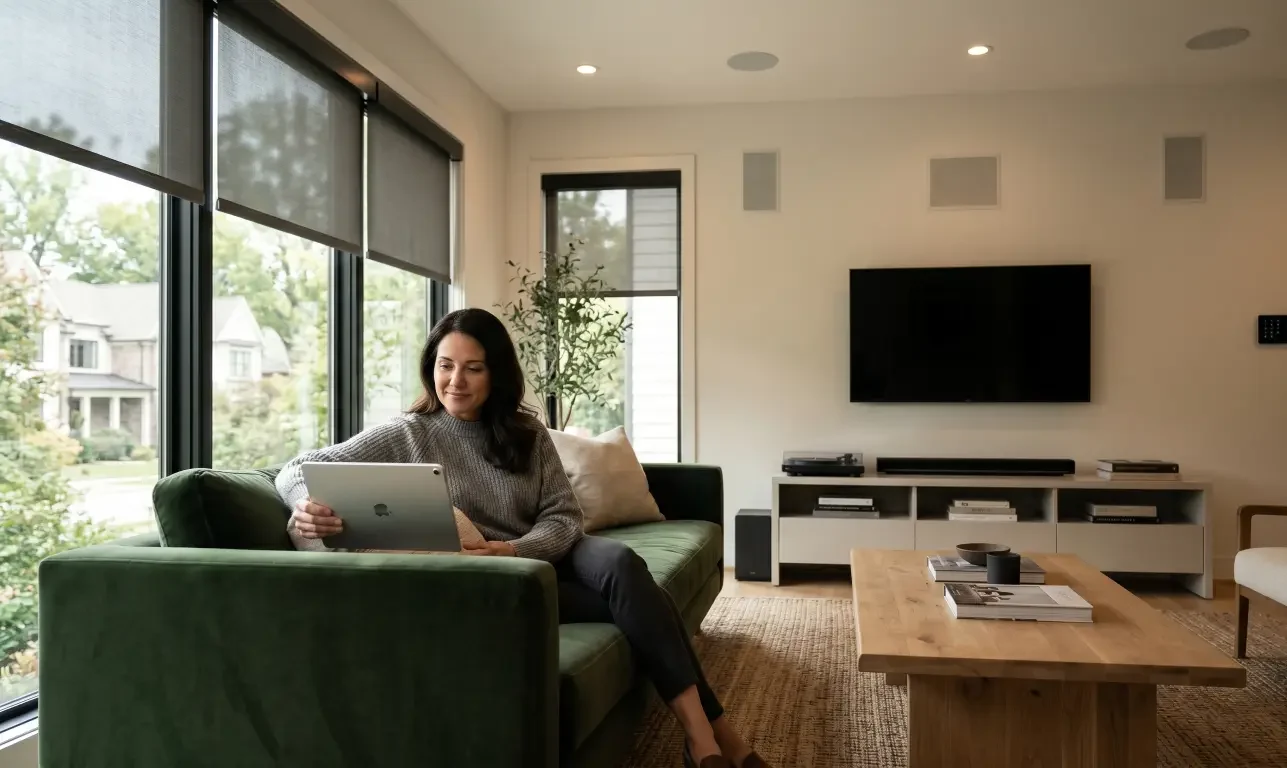
A smart home is supposed to make life easier. Lights should respond when you tap a button. Shades should move when they are scheduled to move. Music should follow you through the house. The theater should turn on without a pile of remotes. The front door, cameras, climate, and security features should feel like part of one home instead of a collection of disconnected gadgets.
But many homeowners discover the opposite. They start with a smart thermostat, add a few voice-controlled lights, install a video doorbell, try a plug-in speaker, download another app, and eventually end up with more complexity than comfort. Some devices work quickly. Others lag. Some automations fail. Some apps update and change. A device that worked yesterday suddenly needs to be reconnected today.
That frustration is exactly why smart home system reliability matters.
A professionally designed system can make a home more consistent, easier to control, and better aligned with how people actually live. But it is also important to understand what a smart home system can and cannot do reliably before you invest in a bigger solution.
The goal is not magic. The goal is thoughtful design, stronger infrastructure, better device choices, and a control experience that feels dependable in everyday use.
Why Smart Devices Feel Unreliable in the First Place
Most smart home frustration comes from fragmentation. One device depends on one app. Another depends on a different cloud service. A third uses a separate wireless protocol. A fourth only behaves well when the Wi-Fi signal is strong. Each device may be fine on its own, but the whole experience can feel unstable when they are not planned as a system.
This is why a home full of smart products is not automatically a smart home system. A system is designed around the network, the control platform, device compatibility, room-by-room use, wiring conditions, and the homeowner’s daily routines. A pile of devices is usually designed one purchase at a time.
Reliability problems often show up as slow response times, devices disappearing from apps, scenes that only partly run, voice commands that work inconsistently, lights that do not stay grouped correctly, and family members who each use different apps to control the same room.
A better system starts by reducing those points of confusion.
What a Smart Home System Can Do Reliably
It Can Bring Major Home Functions Into One Control Experience
One of the most dependable benefits of a professionally designed smart home system is unified control. Instead of switching between separate apps for lighting, shades, audio, climate, security, and entertainment, a well-planned platform can bring those functions into a single interface.
That does not mean every device in the home should be forced into the system at any cost. It means the core features should be selected and configured so the homeowner can control the spaces that matter most without hunting through multiple apps.
For a luxury home, this can make a significant difference. A single keypad scene can prepare the kitchen for morning. A touch panel can adjust music, lighting, and shades in the living room. A theater button can lower shades, dim lights, turn on the projector, select the source, and set the audio mode.
That kind of reliability comes from designing the experience, not just installing devices.
It Can Make Common Routines More Consistent
Smart home systems are especially strong when they are used for repeatable routines. Lighting scenes, shade schedules, entertainment presets, whole-home audio zones, and simple arrival or goodnight commands can usually be made more consistent when they are built on compatible equipment and a stable network.
The most reliable routines are the ones with clear logic. For example: turn on pathway lights at sunset, lower west-facing shades in the afternoon, set kitchen lights to a dinner scene, or turn off selected rooms at bedtime. These automations are practical because they match real daily patterns.
A system becomes less reliable when automations are overcomplicated, stacked on top of each other, or dependent on too many conditions that change throughout the day. Good design keeps the homeowner’s experience simple even when the technology behind it is sophisticated.
It Can Improve Performance by Strengthening the Network
Many smart home complaints are actually network complaints. If the Wi-Fi is weak, overloaded, poorly placed, or inconsistent, connected devices will feel unreliable no matter how advanced they are.
A professional integrator looks at the home as a technology environment. That may include access point placement, wired backbones where possible, equipment locations, rack organization, device load, interference, coverage gaps, and how entertainment systems, cameras, speakers, and automation devices share the network.
This is one reason high-end automation often begins with infrastructure. The control system can only be as dependable as the network supporting it.
It Can Reduce Remote and App Clutter
A smart home system can also simplify the user experience. Instead of five remotes in the media room and six apps for the house, the system can create a cleaner control layer.
That matters for everyday usability. Guests do not want a tutorial just to turn on the television. Family members should not have to remember which app controls which shade. A good system hides complexity so the home feels easier to use.
This is where design details matter: labeled keypads, clean touch panel layouts, intuitive room names, practical scenes, and a control interface that matches how the household talks about its own spaces.
What a Smart Home System Cannot Guarantee
It Cannot Make Every Consumer Gadget Behave Like Professional-Grade Equipment
Not every smart device is built for the same level of reliability. Some products are designed for quick DIY setup, occasional use, or low-cost experimentation. Others are designed to be part of a professionally installed system.
A high-end automation platform can often integrate with many devices, but integration is not the same as full control quality. If a device has limited support, unstable firmware, poor network behavior, or weak compatibility, it may still create problems.
A professional recommendation may sometimes be to replace certain devices rather than keep forcing them into the system. That can feel frustrating at first, but it is often the cleanest path to reliability.
It Cannot Eliminate Every Cloud Dependency
Local control is one of the most important smart home reliability concepts. When a command can run inside the home on the local network, it is often faster and less dependent on an outside server. That can improve response time and reduce failure points.
However, not every feature is fully local. Voice assistants, remote access, streaming services, app accounts, firmware updates, weather-based automations, and certain device ecosystems may still rely on cloud services. If a third-party cloud service is down, changed, or discontinued, some features may be affected.
The practical goal is not to pretend the cloud does not exist. The goal is to design the most important daily controls so they are as locally resilient as possible and to understand which features still depend on external services.
It Cannot Overcome Poor Power, Bad Wiring, or Unrealistic Placement
Smart home reliability is physical as well as digital. Devices need power. Keypads, shades, speakers, access points, screens, cameras, and control processors need appropriate locations. Some products need wiring. Others need clear signal paths. Outdoor systems need weather-aware planning.
If a device is placed too far from the network, installed in a poor location, connected to unstable power, or added after walls are closed with no plan for wiring, reliability can suffer.
This is why homeowners building or remodeling should involve an AV and automation integrator early. Planning before drywall, cabinetry, window treatments, and finishes are finalized can prevent expensive compromises later.
It Cannot Replace Support and Maintenance Forever
A smart home system is not a one-time appliance that never changes. Apps update. Devices receive firmware updates. Streaming platforms change login rules. Homeowners add rooms, displays, shades, speakers, or security features. Internet providers change equipment. Family routines evolve.
A reliable system should be documented, serviceable, and designed cleanly enough that it can be supported over time. But it still benefits from professional maintenance when changes occur.
Long-term reliability is not just the installation. It is the relationship between design, documentation, support, and future upgrades.
Local vs. Cloud Control: The Plain-English Difference
Local control means the command can happen inside your home network. For example, a keypad press tells the lighting system to run a scene without needing to ask a distant server for permission. This can make everyday controls faster and more dependable.
Cloud control means the command relies on an outside service. Voice assistants, remote mobile access, some app-based devices, and some integrations may need internet connectivity and vendor servers to work correctly.
Cloud features are not automatically bad. They can be useful, convenient, and sometimes necessary. The issue is dependency. If every important function depends on a chain of internet service, app accounts, cloud platforms, and third-party integrations, there are more places for something to break.
A well-designed smart home usually balances both. Critical daily controls should be as direct and dependable as possible. Cloud features can add convenience, but they should not be the only way to use the home.
The Role of a Single App or Unified Interface
A single app can make a smart home easier to use, but it is not the whole solution by itself. The real value is the system design underneath the app.
If the platform is well chosen, the devices are compatible, the network is strong, and the scenes are thoughtfully programmed, a unified interface can feel simple and reliable. If the system is just pulling together mismatched devices without a plan, one app may only hide the confusion temporarily.
For homeowners, the better question is not “Can everything be in one app?” The better question is “Which features should be unified, which devices are worth integrating, and what will make the home easier to live in every day?”
Sometimes the answer is a full smart home platform. Sometimes it is a phased plan that starts with lighting, shades, networking, and media control before expanding into more advanced automation.
Signs Your Current Smart Home Setup Needs a Professional Plan
A professional smart home consultation may be worthwhile if your home has several devices but no clear system, if family members avoid using the technology, or if your entertainment rooms depend on too many remotes and workarounds.
Other signs include Wi-Fi dead zones, unreliable shade or lighting schedules, audio zones that do not behave consistently, smart devices that disappear from apps, poor outdoor entertainment performance, or a renovation that will add new technology needs.
The issue is not that every homeowner needs the most complex system available. The issue is that luxury homes often need a better plan than consumer devices can provide on their own.
How AVI Group Approaches Smart Home Reliability
AVI Group designs and installs high-end AV, smart home, automation, lighting, shading, networking, security, outdoor entertainment, home theater, golf simulator, and commercial AV systems in the Atlanta area. That range matters because smart home reliability is rarely about one device category by itself.
A theater depends on video, audio, lighting, networking, control, seating layout, and room design. Whole-home audio depends on zones, wiring, speakers, amplification, sources, and user control. Smart shades depend on power, window conditions, scheduling, and integration with lighting and climate routines. A reliable home automation experience brings these pieces together in a way that feels natural.
The right plan should begin with how the homeowner wants to live: how rooms are used, which routines matter, what needs to be controlled quickly, where performance matters most, and what should remain simple.
From there, AVI Group can help evaluate the existing technology, identify weak points, recommend better infrastructure, and design a system that supports both daily convenience and premium entertainment.
What to Expect From a Realistic Smart Home Consultation
A useful smart home consultation should not start with a pile of product names. It should start with questions.
Which rooms frustrate you most? What devices already exist? What works well today? What fails? Do you prefer wall keypads, touch panels, mobile app control, voice control, or a mix? Are you remodeling, building, or upgrading an existing home? Do you want whole-home control right away, or should the plan be phased?
The integrator should also ask about network performance, wiring access, entertainment goals, lighting and shade expectations, security needs, and how different family members use the home.
That discovery process is what turns smart home technology from a gadget collection into a designed system.
Final Takeaway: Reliability Comes From Design, Not Hype
A smart home system can make daily living easier, reduce app clutter, improve control, strengthen routines, and create a more polished experience across lighting, shades, audio, theater, climate, and security. It can also make technology feel more natural in a luxury home.
But it cannot guarantee that every device, cloud service, app, internet provider, or future update will behave perfectly forever. The most reliable systems are built with realistic expectations, strong infrastructure, compatible products, thoughtful programming, and supportable design.
If your current smart home feels chaotic, the next step is not necessarily adding more devices. It may be stepping back and designing the system properly.
AVI Group offers free consultations for homeowners who want a smarter, cleaner, and more dependable technology experience across their home.
FAQs
Why Do Smart Home Devices Stop Working?
Smart devices can stop working because of weak Wi-Fi, cloud service problems, app updates, dead batteries, poor device compatibility, overloaded networks, or changes to account settings. In many homes, the issue is not one device but the lack of a coordinated system design.
Is Local Smart Home Control More Reliable Than Cloud Control?
Local control is often faster and more resilient for everyday functions because commands can run inside the home network. Cloud control can still be useful for remote access, voice assistants, and certain integrations, but it adds outside dependencies.
Can One App Control Lights, Shades, Audio, and Security?
In many professionally designed systems, one app or interface can control major home functions such as lighting, shades, audio, climate, security, and entertainment. The quality of that experience depends on platform choice, device compatibility, programming, and network design.
Do I Need to Replace All My Existing Smart Devices?
Not always. Some existing devices may integrate well, while others may be unreliable or limited. A smart home consultation can help determine what is worth keeping, what should be replaced, and what should be phased into a better system over time.
What Makes a Smart Home System More Reliable?
Reliability usually comes from a strong network, compatible devices, thoughtful wiring, local control where appropriate, clean programming, practical scenes, clear user interfaces, and ongoing support. Product choice matters, but system design matters just as much.
When Should I Involve a Smart Home Integrator?
Bring in an integrator early if you are building, remodeling, adding shades, upgrading entertainment rooms, planning whole-home audio, or trying to fix a scattered smart device setup. Early planning can prevent wiring, placement, and compatibility problems later.
RELATED LINKS: