
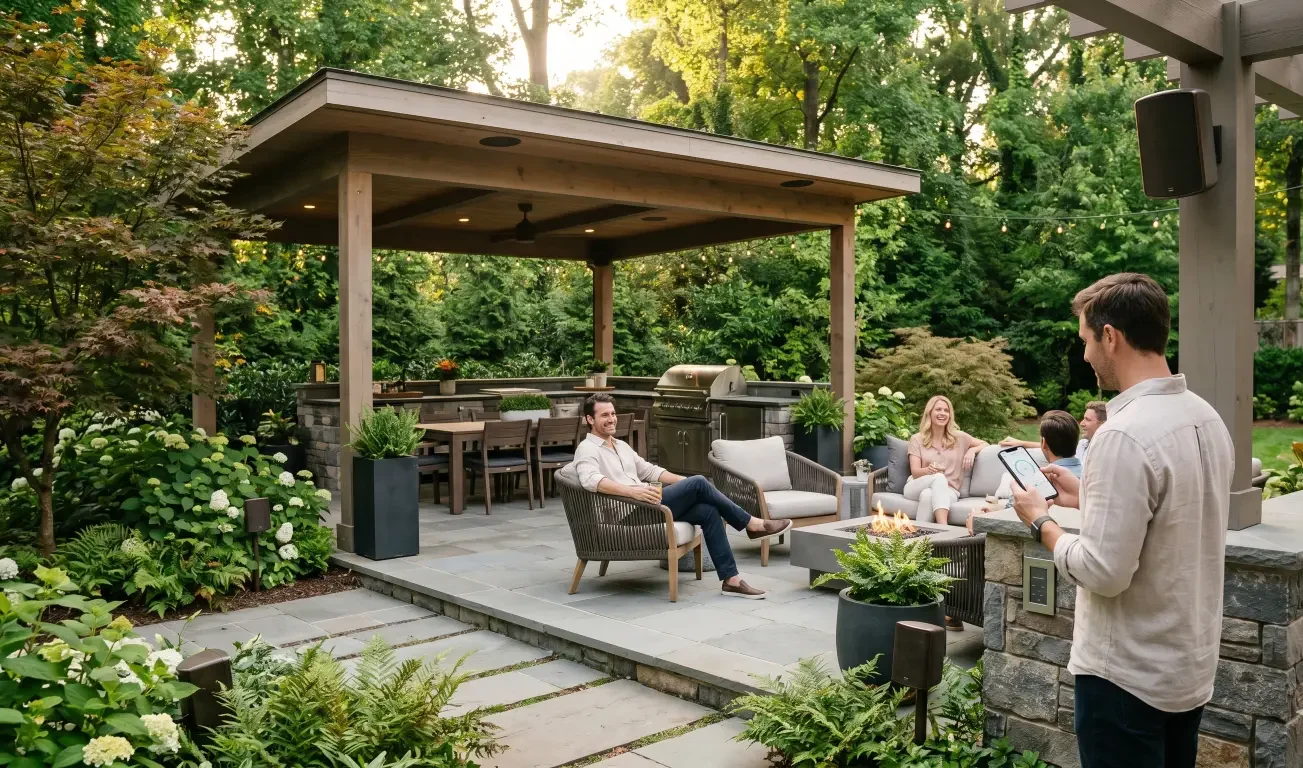
Outdoor audio can make a patio feel like a true living space. Music can support dinner outside, game-day gatherings, pool time, quiet mornings, and evening entertaining. But if the speakers are placed poorly, the experience can quickly become frustrating. One seat may be too loud while another barely hears the music. Guests may keep asking for the volume to go up. Neighbors may hear more than the people on the patio.
That is why outdoor speaker placement patio planning matters. The goal is not simply to install louder speakers. The goal is to create even coverage, comfortable volume, and clean control across the spaces where people actually gather.
A good outdoor audio design uses the right number of speakers, thoughtful directionality, proper mounting height, zone planning, and professional calibration. Instead of blasting from one corner, the system spreads sound across the patio so everyone can enjoy the same atmosphere without unnecessary volume.
Why Outdoor Audio Is Harder Than Indoor Audio
Indoor rooms help contain sound. Walls, ceilings, furniture, rugs, and room boundaries all affect how music behaves. Outdoors, sound has fewer surfaces to reflect from and fewer boundaries to hold it in place. That means a single speaker has to work much harder to cover a patio, deck, pool, or backyard.
This is why one loud speaker often performs worse than several well-placed speakers. When sound comes from only one direction, people close to the speaker get too much volume while people farther away hear less detail. Turning up the volume may solve one listener’s problem but create a new problem for everyone else.
Outdoor spaces also have more background noise. Wind, traffic, neighbors, pool equipment, conversations, grills, and landscaping can compete with music. A good patio audio design considers those conditions instead of assuming an indoor speaker strategy will work outside.
Start With Listening Areas, Not Speaker Locations
Before deciding where speakers should go, define where people will listen. A patio may have several listening areas: an outdoor dining table, lounge seating, grill station, pool deck, covered porch, fire pit, or pergola. Each area may need a different sound level and speaker direction.
Walk the space and ask practical questions. Where do guests sit most often? Where do people stand during parties? Which areas need background music only? Which areas need stronger coverage for entertaining? Where are the neighbors closest? Where are the hard surfaces, rooflines, columns, and open edges?
This step prevents a common mistake: placing speakers where they are easiest to mount rather than where they will sound best. Convenience matters, but the listener experience should drive the design.
Use More Speakers at Lower Volume
The most important principle for even outdoor coverage is simple: use more speakers at lower volume instead of fewer speakers at higher volume. This approach spreads sound across the patio and reduces loud spots.
For example, one pair of speakers mounted near the house may cover a small porch. But a larger patio with a dining area, outdoor kitchen, and lounge seating may need multiple speaker pairs or a combination of surface-mounted, landscape, and subwoofer elements. With more coverage points, each speaker can play at a more comfortable level.
This also helps with neighbor control. A system that depends on high volume from one location tends to throw sound beyond the listening area. A distributed system can keep the music focused where people are actually sitting.
Think in Zones
A zone is an area that can be controlled independently. For outdoor entertainment, zones are especially useful because not every outdoor space needs the same music or volume at the same time.
A covered patio might be one zone. A pool area might be another. A fire pit or lower terrace might be a third. During a party, you may group the zones together so the same playlist plays across the backyard. On a quiet evening, you may turn on only the dining area at a lower volume.
Zone planning also helps avoid outdoor audio coverage problems. If the patio and pool are treated as one large space, the volume may never feel right. If they are separate zones, each area can be adjusted for its own use, distance, and noise level.
Mount Speakers at the Right Height
Mounting height affects coverage, clarity, and comfort. Speakers mounted too low can be blocked by furniture, plants, grills, or people. Speakers mounted too high may project over the listening area or create uneven sound.
For many patios, wall-mounted or surface-mounted speakers work best when they are high enough to clear obstacles but aimed toward the listening area rather than straight across the yard. Under a covered patio, pergola, or porch roof, speakers should be placed so they do not fire directly into corners or reflective surfaces that make the sound harsh.
Landscape speakers follow a different logic. They may sit lower in planting beds or around the perimeter, aimed inward toward the seating area. This can create a more immersive effect because the sound surrounds the patio instead of coming only from the house.
Use Directionality to Avoid Blasting Neighbors
Directionality is one of the most important parts of outdoor speaker design. Speakers should be aimed toward the listening area, not toward property lines, neighboring homes, or open spaces where sound will travel without benefit.
A common mistake is mounting speakers on the back wall of the house and pointing them outward across the yard. That may seem logical, but it can send sound away from the patio and toward neighbors. In many cases, it is better to aim speakers back toward the house or inward toward the listening area.
The goal is controlled coverage. People on the patio should hear full, comfortable sound, while the system avoids throwing unnecessary volume into areas where no one is listening.
Plan for Bass Carefully
Bass behaves differently outdoors. Low frequencies spread widely and can be felt beyond the patio. Without proper planning, homeowners may turn up the system to get more fullness, which can make the whole setup too loud.
A dedicated outdoor subwoofer or landscape subwoofer can help the system sound fuller at lower overall volume. The key is placement and tuning. A subwoofer should support the listening area without overwhelming it or sending excessive low-frequency energy toward neighbors.
Bass planning is one of the reasons outdoor audio benefits from professional design. The difference between pleasant fullness and annoying rumble can be a matter of placement, equipment choice, and calibration.
Match Speaker Type to the Patio Layout
Different outdoor spaces call for different speaker types. Surface-mounted speakers can work well on covered patios, exterior walls, and pergolas. In-ceiling outdoor-rated speakers may work under certain covered areas. Landscape speakers can blend into planting beds and distribute sound around larger areas. Rock-style speakers can be useful in some landscapes when aesthetics matter. Outdoor subwoofers can add depth without relying on excessive volume.
The right choice depends on the architecture, sightlines, wiring access, exposure to weather, and the desired listening experience. A clean design should blend into the space rather than making the patio look crowded with equipment.
For luxury homes, aesthetics are often just as important as performance. Speaker placement should respect outdoor furniture, lighting, landscaping, pool features, and architectural details.
Avoid Common Patio Speaker Placement Mistakes
The first mistake is relying on one speaker or one speaker pair to cover too much area. This usually creates loud spots and dead zones.
The second mistake is pointing speakers outward toward neighbors. That can make the system feel louder outside the patio than inside it.
The third mistake is ignoring furniture placement. Speakers should support the way people actually sit and move, not just the shape of the deck.
The fourth mistake is forgetting about volume control. If the outdoor area is not divided into zones, the homeowner may struggle to balance the dining area, lounge space, and pool.
The fifth mistake is underestimating wiring and network needs. Outdoor audio may need weather-rated wiring, clean equipment locations, reliable control, and integration with the broader home audio system.
How Many Outdoor Speakers Do You Need?
There is no universal number because every patio is different. A small covered porch may need only one pair of speakers. A large backyard with multiple seating areas may need several pairs, landscape speakers, and a subwoofer. A pool and patio combination may need separate zones so the system does not overplay one area while under-serving another.
Instead of starting with a speaker count, start with coverage goals. How large is the space? How many listening areas exist? How loud does the system need to play? How close are the neighbors? Will the system be used for background music, parties, TV audio, or all of the above?
A professional design can translate those goals into the right number, type, and placement of speakers.
Consider Patio Speakers Under a Pergola or Covered Area
Pergolas, covered patios, and porches can be excellent locations for outdoor audio, but they need careful planning. Columns, beams, ceiling height, fans, heaters, lighting, and furniture can all affect placement.
Speakers should be mounted where they can cover the seating area evenly without competing with fans, lights, or architectural features. If a pergola is open on multiple sides, directionality becomes especially important. The speakers may need to aim inward or downward so the sound stays near the patio.
If the covered area connects to an open yard or pool, it may make sense to treat the pergola as one zone and the open area as another. That gives the homeowner more control during different types of gatherings.
Integrate Outdoor Audio With the Whole-Home System
Outdoor audio works best when it is not an isolated add-on. If the home already has whole-home audio, lighting control, smart home automation, or outdoor entertainment systems, the patio speakers should fit into that larger ecosystem.
This allows simple control. A homeowner might start music inside, extend it to the patio, lower the pool zone, adjust outdoor lighting, and control everything from one app or interface. For entertaining, that ease of use matters as much as sound quality.
Integration also supports future expansion. A homeowner might begin with the patio and later add the pool, garden, outdoor kitchen, or detached pavilion. Planning the infrastructure early can make those additions cleaner.
How AVI Group Helps Plan Outdoor Audio Coverage
AVI Group designs and installs custom AV, whole-home audio, smart home automation, outdoor entertainment, networking, security, lighting, and related technology systems for homeowners across the Atlanta metro area. For outdoor audio, that experience matters because patios and backyards require more than simply mounting speakers.
A professional design process can evaluate the patio layout, architecture, speaker locations, wiring, amplifier needs, control preferences, zoning, and neighbor considerations. The goal is a system that feels powerful when needed but comfortable in everyday use.
For homeowners in Atlanta, Alpharetta, Kennesaw, Dunwoody, Canton, and surrounding communities, AVI Group can help turn an outdoor space into a polished entertainment environment with balanced sound and easy control.
Outdoor Speaker Placement Checklist
Use this checklist before planning a patio audio system:
- Identify every outdoor listening area.
- Decide which areas should be separate zones.
- Avoid relying on one loud speaker to cover the whole patio.
- Aim speakers toward people, not property lines.
- Choose speaker types that fit the architecture and landscape.
- Plan mounting height around furniture, fans, beams, and sightlines.
- Consider a subwoofer for fuller sound at lower volume.
- Account for wiring, weather exposure, and equipment location.
- Test the system at normal listening levels, not just maximum volume.
- Plan for future expansion if the outdoor space may grow.
Final Thoughts
Even patio sound is not about making everything louder. It is about putting the right speakers in the right places, dividing the space into useful zones, aiming sound carefully, and designing the system around how the outdoor area is actually used.
If your current outdoor speaker setup has loud spots, weak areas, or neighbor complaints, the problem may not be the music or the volume. It may be the design.
AVI Group can help Atlanta-area homeowners plan outdoor audio that feels balanced, refined, and easy to use. Book a free consultation to discuss your patio, backyard, or outdoor entertainment goals.
FAQ
Where should outdoor speakers be placed on a patio?
Outdoor speakers should be placed to cover the actual seating and gathering areas, not simply where they are easiest to mount. Aim speakers toward listeners and away from neighboring properties when possible.
How many outdoor speakers do I need for a backyard?
The number depends on the size of the space, listening areas, desired volume, speaker type, and whether the yard needs multiple zones. Larger patios usually sound better with more speakers at lower volume rather than one or two speakers playing loudly.
How can I get outdoor audio coverage without loud spots?
Use distributed speaker placement, proper aiming, zone control, and balanced volume levels. Multiple well-placed speakers usually create more even coverage than a single loud source.
How do I avoid bothering neighbors with outdoor music?
Aim speakers inward toward the listening area, use more speakers at lower volume, avoid pointing sound toward property lines, and consider a system design that focuses coverage where people gather.
Can outdoor speakers connect to a whole-home audio system?
Yes. Outdoor speakers can often be integrated with whole-home audio and smart home controls, allowing the patio, pool, kitchen, living room, and other zones to work together or operate independently.
RELATED LINKS:
CEDIA – Home Technology Association / Smart Home Professional resources