
Kitchen lighting scenes work best when they solve different visual tasks instead of forcing one brightness level to handle everything. A kitchen may need strong counter illumination while preparing food, softer ambient light during breakfast, balanced light for entertaining, and a low-level path at night. When every recessed fixture, pendant, and under-cabinet strip turns on together at full output, the room can feel harsh—especially around polished stone, glossy cabinetry, stainless appliances, and bright white surfaces.
AVI Group designs lighting and smart-home systems for Atlanta-area homes, with current services that include layered lighting plans, quiet dimming, scenes, tunable white, shade automation, and unified control. That makes the kitchen a natural place to use automation for comfort: instead of thinking only about fixtures, design a handful of scenes around what people actually do in the room.
Why One Kitchen Lighting Level Rarely Works
The kitchen combines several visual jobs in one room. You need clear task light for chopping and reading labels, general light for moving safely, softer light for conversation, and often accent light for architectural details. The Illuminating Engineering Society defines task-ambient lighting as a combination in which the general ambient level is lower and complementary to the task light. That concept is useful in kitchens because the brightest light can be placed where work is happening instead of flooding every surface equally.
U.S. Department of Energy residential lighting guidance similarly treats kitchens as spaces that benefit from separate task and ambient layers. It notes that under-cabinet lighting can reduce shadows on counters and that thoughtful recessed placement can provide useful illumination while improving glare control.
1. Separate Task Light From Ambient Light
Start by asking what each fixture is supposed to do. Recessed ceiling fixtures, pendants, under-cabinet strips, toe-kick lighting, decorative fixtures, and daylight should not all be treated as one zone.
- Task lighting: counters, sink, range, island work surfaces, pantry work areas.
- Ambient lighting: general room illumination for movement and orientation.
- Accent lighting: shelving, art, architectural details, glass cabinets, or decorative features.
- Night lighting: low-level paths that make the kitchen usable without waking the entire house.
When these layers are separately dimmable, the homeowner can raise task light while keeping ambient levels lower, or do the reverse when the room is being used socially rather than for food preparation.
2. Use Under-Cabinet Lighting to Reduce Counter Shadows
Ceiling light alone can create a frustrating problem: the person standing at the counter blocks the light that is supposed to illuminate the work surface. Under-cabinet lighting puts light closer to the task and can reduce those shadows.
The best result usually comes from treating under-cabinet lighting as its own controllable layer. It may be bright during meal preparation, moderate during cleanup, and very low during early-morning or late-night use. The exact output, color quality, diffusion, and placement should be selected for the cabinetry and counter material so the strip itself does not become a visible source of glare.
3. Control Glare From Polished Surfaces
Glare is not only about fixture brightness. It is also about geometry. Polished quartz, marble, glossy tile, stainless appliances, glass cabinet doors, and high-sheen paint can reflect bright light sources into the eye.
To diagnose a harsh kitchen, stand at the places where people actually work and look for visible reflections of downlights, pendants, or linear LEDs. If you can see a bright source reflected directly off the island or backsplash, simply dimming the entire kitchen may not be the best fix.
Possible design responses include changing fixture aiming, using better shielding or diffusion, adjusting pendant height, separating zones, reducing output in selected fixtures, and coordinating daylight with motorized shades. The right solution depends on the room and should be tested in the finished sightlines.
4. Build an Early-Morning Scene
Early mornings often call for enough light to make coffee, prepare breakfast, and move safely without starting the day under full-output ceiling lights.
A useful early-morning scene might use:
- Under-cabinet task lighting at a moderate level.
- Selected pendants or ceiling lights at a lower level.
- Warm or neutral-white settings where tunable lighting is installed.
- Shades opening gradually when daylight becomes useful.
- No decorative or accent zones unless they add real value.
The objective is not to create a medically prescribed circadian routine. It is simply to make the kitchen easier to use when the household wants less visual intensity.
5. Create a Cooking Scene
The cooking scene should prioritize visibility on work surfaces. This is where brighter task lighting earns its place.
- Raise under-cabinet lighting.
- Bring island or peninsula task lighting to an appropriate working level.
- Use enough ambient ceiling light to keep the whole room visually balanced.
- Keep decorative zones lower if they create reflections or visual clutter.
DOE guidance specifically notes the value of task lighting at counters and the role of recessed or pendant fixtures for peninsulas and freestanding work surfaces. The important design decision is not “bright versus dim”; it is where brightness is needed.
6. Add a Cleanup Scene
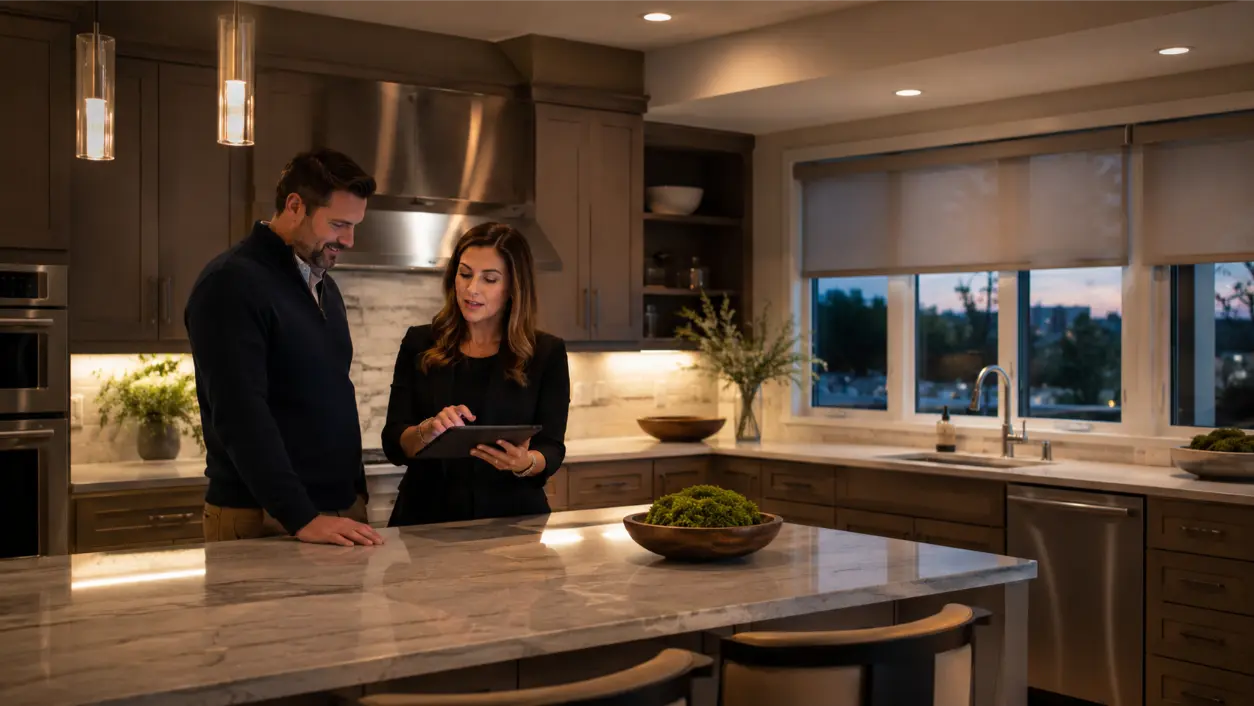
Cleanup needs clear light, but it may not need the exact same balance as cooking. After dinner, a homeowner may want stronger light around the sink and counters while keeping the surrounding room calmer.
A cleanup scene can raise sink, counter, and under-cabinet zones while leaving pendants and general ambient lighting slightly lower. This can make it easier to see crumbs, spills, and dishes without making the entire open-plan living area feel like a workspace.
7. Use an Entertaining Scene to Lower Visual Intensity
When guests gather around an island, maximum task lighting can make the kitchen feel clinical. An entertaining scene can shift emphasis from work surfaces to faces, architecture, and comfort.
- Dimming the brightest downlights.
- Keeping pendants at a comfortable social level.
- Using selected accent or shelf lighting.
- Reducing under-cabinet output unless food service still requires it.
- Coordinating adjacent dining or living-room scenes so the open floor plan feels coherent.
AVI Group’s current lighting positioning emphasizes layered plans and scenes that match décor and lifestyle. In a kitchen, that means the same hardware can support both active food preparation and a more relaxed evening atmosphere.
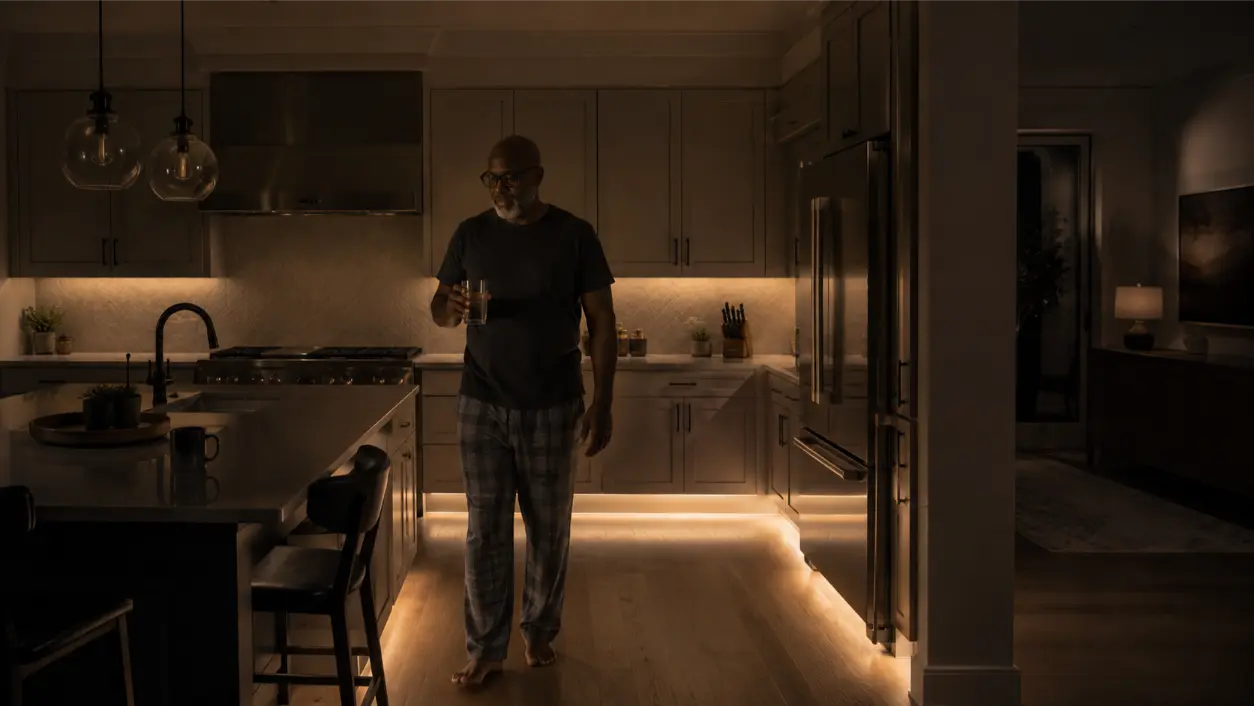
8. Create a True Night Mode
A night scene should not be a dimmed version of every fixture. It should identify the minimum light needed for safe navigation and a simple task such as getting water.
Useful night-mode sources may include toe-kick lighting, a low under-cabinet zone, a small pantry or beverage-area light, or selected low-output ceiling fixtures. The goal is to avoid a sudden wall of light while still keeping paths, edges, and counters visible.
Keep manual control available. Automation should never leave the homeowner unexpectedly in darkness because a schedule or sensor did not behave as expected.
9. Coordinate Shades With Daylight
Daylight can be beautiful in a kitchen, but it can also create strong contrast and reflections. A bright window next to a darker interior can make the room feel visually uneven, while direct sun on polished counters can increase glare.
AVI Group’s current smart-home offering includes motorized shades with schedules and integration. In a kitchen, shades can be part of a scene rather than a separate afterthought. A morning scene may open them; an afternoon cooking scene may lower them on a sun-exposed elevation; an entertaining scene may balance privacy and interior light.
Shade automation should be tuned to the actual orientation of the house and homeowner preference rather than copied from a generic sunrise/sunset schedule.
10. Use Tunable White Carefully
Tunable-white lighting can change the apparent warmth or coolness of the room, but it should support the interior design rather than become a novelty. Stone, wood, paint, cabinetry, food, and skin tones can all look different as color temperature changes.
Keep the number of user-facing options small. For many homeowners, a few well-designed scenes are easier than a slider that exposes every possible color-temperature setting.
11. Keep Controls Simple
A good kitchen system should not require opening an app every time someone wants to cook. Use wall keypads or dimmers for the scenes that matter most, with app or voice control as secondary options where useful.
- Morning.
- Cooking.
- Entertain.
- Cleanup.
- Night.
- All Off.
The names should match the household’s language. If a scene needs explanation every time, it is probably too complicated.
12. Commission the Kitchen at the Times That Matter
Lighting scenes should be tuned in real conditions. A scene programmed at noon may feel completely different at 6:00 a.m. or after sunset.
- In daylight.
- At early-morning light levels.
- After dark.
- With glossy appliances and counters visible from normal positions.
- With adjacent living and dining lights set to their typical evening levels.
Then adjust dimming, shade position, fixture balance, and scene transitions. The goal is not a mathematically perfect preset. It is a set of scenes that feels comfortable and predictable in daily life.
Kitchen Lighting Scene Checklist
- Separate task, ambient, accent, and night lighting into useful zones.
- Give under-cabinet lighting independent control.
- Check counter, backsplash, appliance, and cabinet reflections from real standing positions.
- Create an early-morning scene with lower visual intensity.
- Create a brighter cooking scene focused on work surfaces.
- Create a cleanup scene that supports sink and counter visibility.
- Create an entertaining scene with lower ambient intensity.
- Create a true night mode using only the lighting needed for safe movement.
- Coordinate shades with sun exposure and privacy.
- Keep tunable-white options simple.
- Use wall controls for everyday scenes.
- Test and tune scenes at multiple times of day.
Frequently Asked Questions
What Are the Best Kitchen Lighting Scenes?
Most kitchens benefit from a small set built around real activities: Morning, Cooking, Cleanup, Entertain, Night, and All Off. The exact scenes should reflect the room layout and household routine.
Can Under-Cabinet Lighting Help Reduce Glare?
It can improve task visibility and reduce shadows, but poor placement or visible LED sources can create their own glare. Use appropriate diffusion, placement, and dimming for the specific cabinetry and counter material.
How Do I Make My Kitchen Less Harsh at Night?
Reduce the number of active zones rather than dimming every fixture equally. Use lower-level under-cabinet, toe-kick, pendant, or selected ambient lighting and avoid bright reflected sources in polished surfaces.
Should Kitchen Task and Ambient Lights Be on Separate Dimmers?
Often, yes. Separate control lets the homeowner increase light where detailed work is happening while keeping the general room level lower and more comfortable.
Can Smart Shades Be Part of a Kitchen Lighting Scene?
Yes. In homes with motorized shades, the shade position can coordinate with lighting scenes to manage daylight, privacy, and reflections. The settings should be tuned for the home’s actual window orientation and use patterns.
Design the Kitchen Around How You Actually Use It
The most useful kitchen lighting system is not the one with the most scenes. It is the one that makes everyday transitions easier: bright where you need to work, softer when you want to relax, and low enough at night to move through the room without unnecessary visual intensity.
AVI Group designs integrated lighting, shade automation, and smart-home systems for Atlanta-area homes, with layered lighting plans, dimming, scenes, and tunable-white options built around the way each household lives. Homeowners who want to improve a harsh or inflexible kitchen can book a free consultation with AVI Group to review fixture zones, controls, shades, daylight, and scene programming.
Lighting, electrical, and health disclaimer: This article provides general planning information and is not medical, ophthalmic, electrical, building-code, or lighting-engineering advice. Lighting needs and sensitivity to glare vary by person, room, fixture, finish, age, and health. Smart lighting cannot guarantee relief from eye strain or headaches. Electrical modifications and fixture/control selection should be completed by qualified professionals following applicable codes and manufacturer instructions.
RELATED LINK: U.S. Department of Energy — Strategy Guideline: High Performance Residential Lighting