
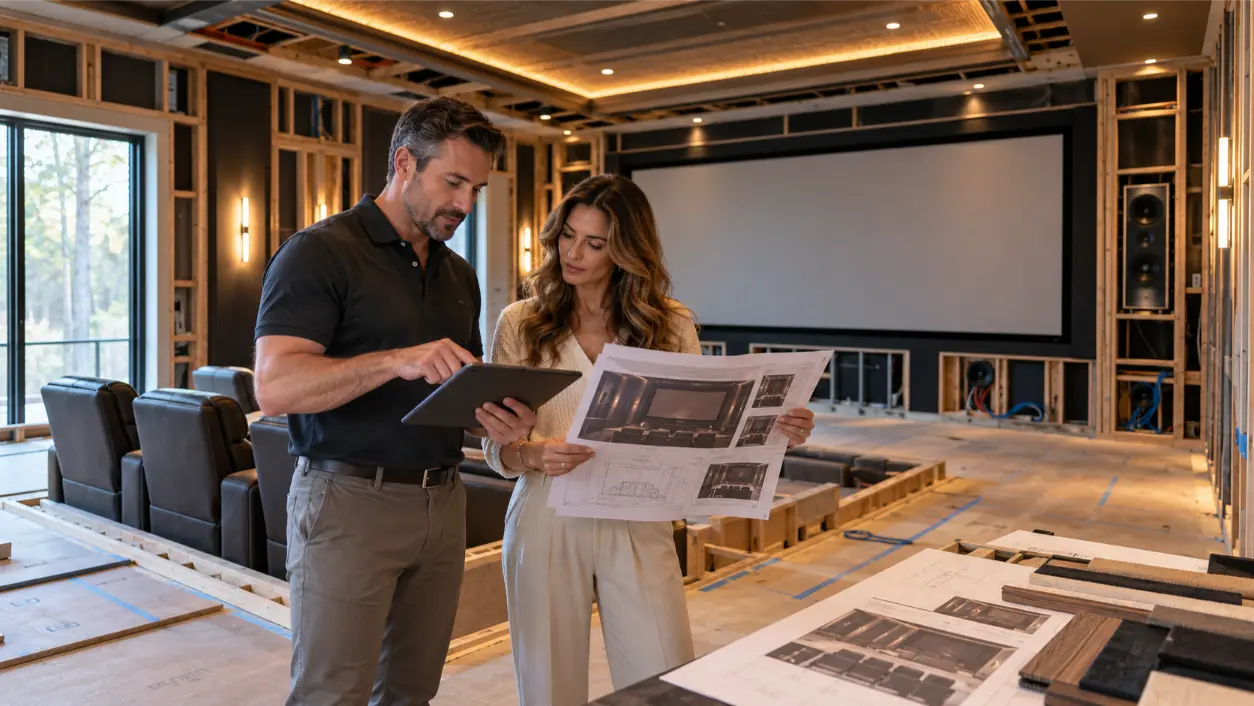
For an Atlanta homeowner, home theater cost is not determined by one equipment package. A professionally designed theater is a room system: construction, sightlines, display technology, speaker layout, acoustics, seating, lighting, control, networking, and finish work all interact. Two rooms with the same seat count can have very different budgets because one needs AV integration while another needs structural changes, sound isolation, custom millwork, or deeper automation.
Start With the Room Before You Start With the Equipment
The room is often the first major budget decision because it determines what the system must overcome. A dedicated basement theater with controlled light, finished walls, existing electrical service, and usable ceiling height is a different project from an unfinished space that needs framing, HVAC work, electrical changes, risers, acoustic isolation, cabinetry, or a new equipment location.
CEDIA’s homeowner guidance notes that room size and layout affect screen size, speaker placement, lighting control, networking, acoustics, and seating. That is why a professional design process usually starts with the room and the viewing experience rather than with a list of brands.
The Eight Decisions That Change a Custom Home Theater Budget
1. Dedicated Theater or Multi-Purpose Media Room?
A dedicated theater gives the designer more control over light, speaker placement, acoustics, seating geometry, and equipment visibility, but it can also expand the scope because the room itself becomes part of the project.
A media room can reuse existing furniture and finishes, but windows, open floor plans, and ambient light may push the design toward different display, speaker, or shade solutions.
2. Television or Projection?
The display decision affects much more than the price of the screen. A large-format television can simplify brightness, maintenance, and everyday use. Projection can create a more cinematic image at very large sizes, but it adds decisions around projector output, throw distance, screen material, room light, mounting, ventilation, and alignment.
With projection, an acoustically transparent screen can place the front speakers behind the image for a cinema-style presentation, but it requires adequate depth and front-wall planning.
3. Screen Size, Seating Count, and Sightlines
Screen size should be chosen together with seating, not in isolation. Dolby’s current home theater setup guidance emphasizes that viewing position affects both picture and sound, and that seating should remain as close to the screen centerline as practical.
Adding a second row can increase the budget because it may require a riser, additional seating, more floor space, altered speaker heights, step lighting, and new sightline calculations. Premium reclining seats, custom upholstery, cupholders, charging, or motorized features can also become a meaningful part of the project.
4. Audio Performance Target
Audio can range from a clean surround system to a high-output immersive system engineered around objective performance targets. The number of speakers is only one factor. Speaker quality, subwoofer count, amplification, processing, room volume, listening distance, speaker placement, and calibration all matter.
CEDIA’s RP22 recommended practice for immersive audio uses defined engineering performance levels rather than vague labels such as good, better, and best. That is useful for budget planning because it reframes the conversation around the level of performance the homeowner wants rather than simply the number of components.
Larger rooms or multiple seating rows may require additional subwoofers or more capable amplification to keep bass and headroom consistent across seats.
5. Acoustic Treatment and Sound Isolation
Acoustic treatment and sound isolation solve different problems. Treatment manages reflections and decay inside the room so dialogue, music, and effects are clearer. Sound isolation attempts to reduce how much theater sound travels into bedrooms, offices, or adjacent living areas.
Basic treatment may involve strategically placed absorptive or diffusive panels. More ambitious isolation can affect wall assemblies, ceilings, doors, penetrations, HVAC paths, electrical boxes, and construction sequencing. If the goal is to watch movies at high volume while the rest of the house remains quiet, that requirement should be discussed early because it can influence the room build itself.
6. Lighting, Shades, and One-Tap Control
A premium theater often includes more than AV equipment. Dimming zones, step lights, sconces, motorized shades, scene control, and integration with climate or whole-home automation can make the room easier to use and more visually polished.
AVI Group’s home automation systems can integrate lighting, shades, climate, audio, video, and other systems into a common interface. For a theater, that can mean one command that starts the system, adjusts the lights, lowers shades, and prepares the room for viewing. The more systems included in that scene, the more design, programming, wiring, and coordination the project requires.
7. Networking, Equipment Racks, Power, and Infrastructure
Streaming, control systems, firmware updates, remote support, and connected source devices all depend on reliable infrastructure. A theater may need new data cabling, dedicated circuits, surge protection, equipment ventilation, an organized rack, or stronger network coverage.
AVI Group’s networking and Wi-Fi work illustrates why connectivity should be planned as infrastructure rather than treated as an afterthought. A homeowner may spend heavily on premium picture and sound only to create a frustrating experience if the network or equipment environment is unstable.
8. Finish Level and How Invisible the Technology Should Be
Technology can be visible and straightforward, or integrated into the architecture. Hidden speakers, custom fabric walls, concealed equipment, millwork, acoustic panels that match the interior, motorized masking, decorative lighting, star ceilings, and other design features can move the project from an AV installation toward a full custom-room build.
The more invisible the system should become, the more coordination may be required with builders, electricians, designers, cabinetmakers, and other trades.
Where Homeowners Commonly Underestimate the Budget
The visible components are easy to think about because they are easy to shop. The less visible work is where many budget surprises begin.
- Electrical circuits, outlets, lighting loads, and power protection.
- Low-voltage wiring, conduit, network infrastructure, and future-proofing.
- Risers, wall modifications, equipment ventilation, and structural work.
- Acoustic treatment or sound-isolation construction.
- Programming, system commissioning, video calibration, and audio tuning.
- Coordination with builders, designers, electricians, and other trades.
- Finish work after speakers, screens, cabling, or equipment are integrated.
A realistic theater budget should therefore include the room, the system, and the labor required to make them function as one design.
How to Build a Home Theater Budget Without Picking a Number Too Early
A useful budget conversation starts with priorities. Instead of asking, “What does a theater cost?” ask what the room must accomplish and which outcomes matter most.
- Define the room: dedicated theater, basement conversion, media room, or new construction.
- Set the seating goal and identify the primary viewing position.
- Choose the desired visual experience: large television, projection, or a design that still needs evaluation.
- Define the audio goal: strong surround sound, immersive Dolby Atmos, or a higher-output reference-style experience.
- Decide how important sound isolation is to the rest of the home.
- Choose the desired finish level, from visible equipment to architectural concealment.
- List the systems that should integrate with the theater, such as lighting, shades, climate, security, or whole-home audio.
- Decide whether the room should be designed for future expansion even if some components are added later.
Once those decisions are clear, a professional integrator can allocate the budget toward the features that have the greatest effect on the homeowner’s actual experience.
What to Prioritize If the Budget Is Limited
If the budget cannot support every wish-list item at once, protect the decisions that are difficult or expensive to change later. Good pre-wire, correct speaker locations, conduit, electrical planning, seating geometry, projector throw requirements, and equipment ventilation are examples of infrastructure that can be costly to redo after walls and finishes are complete.
Some electronics can be upgraded later if the room, wiring, and equipment space were designed intelligently, making a phased plan practical when infrastructure is protected first.
New Construction vs. Retrofit
New construction and major remodels can create opportunities to coordinate framing, electrical, low-voltage cabling, lighting, HVAC, acoustic assemblies, speaker backboxes, and equipment locations before surfaces are closed. That flexibility can reduce rework and help technology disappear into the architecture.
A retrofit can still produce an excellent theater, but access conditions matter. Finished ceilings, concrete walls, difficult cable paths, existing fireplaces, windows, and limited equipment locations can change labor and product choices. The same performance goal may therefore require a different design approach in an existing home.
Why Professional Design Changes the Cost Conversation
AVI Group’s custom home theater service includes room planning, projector and screen installation, immersive audio, acoustic treatment, lighting, control, installation, and calibration. That scope reflects why a theater proposal is better treated as a designed system than as a pile of equipment prices.
A professional design should connect room dimensions, seating, display, audio, acoustics, wiring, control, and finishes before major purchases, so tradeoffs are made where they actually change the experience.
Questions to Ask During a Home Theater Consultation
- Which room conditions are driving the design?
- What are the most expensive-to-change infrastructure decisions?
- How many seats can the room support without compromising sightlines or sound?
- Would a television or projector better fit the room and viewing habits?
- What audio performance level is the system being designed to achieve?
- What acoustic treatment or isolation work is included?
- Which lighting, shade, automation, and networking systems are included?
- What construction or trade work is outside the AV proposal?
- What can be phased now without creating expensive rework later?
- How will the system be calibrated, documented, and supported after installation?
FAQ: Custom Home Theater Cost
How much does a custom home theater cost?
There is no single useful number because the project can range from an AV upgrade in an existing room to a fully built dedicated cinema. Room construction, display type, audio performance, seating, acoustics, lighting, automation, infrastructure, and finish level all change the scope. A design consultation is the most reliable way to translate the room and performance goals into a project budget.
What usually increases home theater installation cost the most?
Major construction or sound isolation, very large projection systems, higher-performance immersive audio, multiple seating rows, premium seating, custom architectural finishes, and deep smart-home integration can all increase the project scope. Which factor matters most depends on the room.
Is a projector always more expensive than a large TV?
No. The comparison depends on screen size, projector performance, screen material, room light, mounting, calibration, and whether the room needs construction to support the projection system. In some rooms a television is the simpler solution; in others projection is the only practical way to reach the desired image size.
Can a home theater be built in phases?
Often, yes. The key is to design the infrastructure for the final vision. Wiring, conduit, speaker locations, power, equipment space, and room geometry should anticipate future upgrades so later phases do not require unnecessary demolition or rework.
Does acoustic treatment really affect the experience?
Yes. Room reflections and bass behavior can change clarity, imaging, and consistency from seat to seat. Acoustic treatment is different from sound isolation, so the design should identify whether the goal is better sound inside the room, less sound outside the room, or both.
The Bottom Line
The cost to build a home theater is shaped less by one brand choice than by the performance and finish decisions made around the room. Start with the space, seating, display, audio target, acoustics, lighting, control, infrastructure, and desired level of architectural integration. Those choices determine which parts of the project deserve the budget.
For Atlanta homeowners, AVI Group can evaluate the room, define the design priorities, and develop a custom proposal around the experience you want rather than forcing the project into a one-size-fits-all package. A free consultation is the natural next step when you are ready to turn the wish list into a coordinated design.
Official Resources
- CEDIA – Home Cinema FAQs for Smart Homeowners
- CEDIA – RP22 Immersive Audio Design Recommended Practice
- Dolby – Home Theater Setup Guide
RELATED LINK: CEDIA – Home Cinema FAQs for Smart Homeowners