
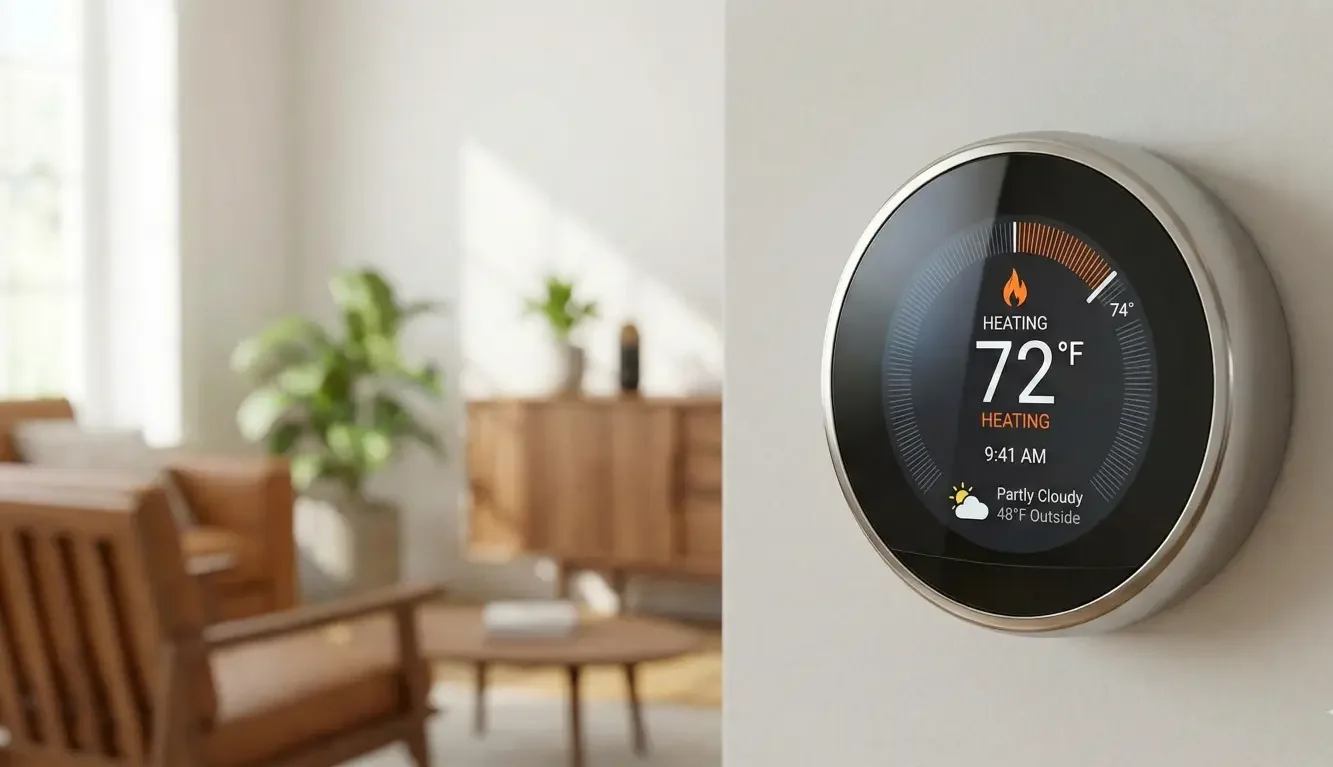
If you manage a large home with multiple HVAC zones, you’ve probably seen this exact pattern: downstairs feels fine, upstairs runs warm, and no amount of schedule tweaking seems to “stick.”
You install a smart thermostat (or add sensors), expecting tighter control—then the complaints get louder. Not because smart thermostats are bad, but because multi-zone comfort is less about the thermostat and more about how the entire system makes decisions.
In a multi-zone property, “comfort” is the end result of a chain: sensor readings → control logic → dampers/airflow → equipment staging → scheduling rules. When any part of that chain is misaligned—or when two different systems try to be the boss—temperatures drift across floors, zones fight each other, and service visits turn into small adjustments that don’t change outcomes.
This guide is built for estate managers: practical, contractor-ready, and focused on the most common failure modes in complex homes—sensor placement, zone priorities, control ownership, and the handoffs between HVAC and automation teams.
The real issue: multi-zone comfort isn’t a thermostat problem—it’s a system-control problem
A typical single-zone home can get away with “good enough” control. A multi-zone home usually can’t.
In practice, “multi-zone” means you’re not just controlling temperature—you’re coordinating a system:
- Zones: separate areas of the home with independent temperature targets.
- Dampers: mechanical doors in the ductwork that open/close to direct airflow.
- Air handler/furnace/heat pump: the equipment producing heating or cooling.
- Control board / zoning panel: the decision-maker that interprets calls from thermostats and commands dampers and equipment staging.
- Thermostats and sensors: the inputs that tell the system what’s happening in each zone.
When temperatures drift across floors, the failure is often not a “bad thermostat.” It’s a mismatch between inputs and decision rules—especially when the system was upgraded in pieces over time (new thermostat, older zoning hardware, added sensors, new automation programming) without a single integration plan.
Large homes amplify small mistakes because the building behaves differently by floor. Sun exposure, stack effect, return locations, ceiling height, and insulation differences all exaggerate what would be minor in a smaller property. That’s why “smart thermostat multi zone problems” frequently show up as the same two symptoms: persistent upstairs/downstairs imbalance and zone behavior that feels unpredictable.
Quick symptom map: what “upstairs too hot / downstairs too cold” is telling you
Before anyone changes settings, it helps to translate the complaints into likely categories. You’re not trying to diagnose the exact component yet—you’re trying to sort the problem into the right bucket so the next service visit is productive.
Common symptom patterns estate managers report:
- Upstairs runs warm in the afternoon, normal at night
- Downstairs feels over-cooled while upstairs never reaches setpoint
- Schedules appear correct, but the home doesn’t follow them
- One zone “steals” heating/cooling and another is always behind
- Rooms near the thermostat feel fine, but the rest of the zone doesn’t
- Comfort improves for a day after a visit, then slowly drifts back
What those patterns often suggest:
- Sensor bias: The system is “seeing” the wrong temperature because sensors are in misleading locations or configured poorly.
- Zoning imbalance: Dampers/airflow are physically limited, so one zone can’t get enough conditioned air when multiple zones call.
- Scheduling/control conflict: Two platforms are fighting—thermostat scheduling vs automation schedules, or thermostat logic vs zoning panel priorities.
The goal is to move from “it’s inconsistent” to “it’s inconsistent in a specific way,” because that’s what allows your HVAC contractor and integrator to collaborate instead of passing the issue back and forth.
Triage Step 1 — Confirm who is in control (thermostat vs zoning panel vs automation system)
If multi-zone systems fail for one predictable reason, it’s this: two masters are giving orders.
You may have:
- A thermostat app schedule
- A zoning panel making priority decisions
- A home automation platform applying its own schedule/occupancy logic
- Remote sensors influencing setpoints or participation rules
When more than one system is effectively “driving,” the property ends up with the worst kind of performance: the system appears to respond, but not consistently—and every change triggers a different side effect.
A useful principle here is the “one brain” rule: the system needs one clear owner for scheduling and decision-making. Other systems can assist, but they must not compete.
Before changing anything, document what the system is doing today:
- Setpoints per zone (heat/cool targets and any offsets)
- Schedules per zone (including vacation/away modes)
- Sensor assignments (which sensor drives each zone—if applicable)
- Who sets schedules (thermostat app, automation platform, or both)
- Any occupancy logic (geofencing, motion-based setbacks, night modes)
- Zone names (make sure “Upstairs” means the same thing to everyone)
This doesn’t need to be complicated—screenshots and a one-page summary are often enough. The point is to stop “fixing” a moving target.
Common integration conflict: automation schedule overrides thermostat schedule
One of the most frustrating experiences is when schedules look perfect, but the house behaves like it’s ignoring them. In many homes, the schedule isn’t being ignored—it’s being overridden.
If the automation platform is changing setpoints or modes behind the scenes, the thermostat schedule may never take effect. Or the thermostat may apply its own logic after the automation system changes something, creating a loop of overrides.
For estate-managed properties, a practical approach is to choose one of these models:
- Thermostat-led scheduling: Thermostat handles setpoints/schedules; automation system only provides high-level triggers (e.g., “away mode”) if coordinated.
- Automation-led scheduling: Automation system sets the schedule; thermostats are configured to accept it without running a competing schedule.
Which is best depends on your ecosystem and who maintains it. What matters is clarity—and that both your HVAC contractor and integrator understand the chosen model.
Triage Step 2 — Sensor placement: the silent reason zones drift
Multi-zone control is only as good as the temperatures it believes. If a zone’s “truth” is measured in a misleading location, the system will work hard to hit the wrong target.
This is why sensor placement matters so much in large homes. A sensor can be technically “working,” but functionally wrong.
Common sensor placement problems that skew readings:
- Hallways with mixed air (not representative of the rooms people care about)
- Exterior walls or near windows (temperature swings and solar influence)
- Near supply vents or returns (reads conditioned air, not room comfort)
- Direct sun exposure (afternoon heat drives false warm readings)
- Near kitchens, laundry rooms, or equipment closets (localized heat sources)
- High on walls in tall spaces (stratification makes the reading misleading)
If your issue is “temperature different upstairs vs downstairs,” sensor placement is one of the first areas to inspect—especially if the home has large open stairwells or uneven sun exposure.
Remote sensors can help, but only if you’re clear about what role they play. If you add sensors without a plan, you can create the impression of better coverage while introducing conflicting inputs.
Remote sensors vs thermostat sensor: when each should drive the zone
In many multi-zone homes, the thermostat’s built-in sensor is not in the best place to represent the zone. Remote sensors may be a better indicator of comfort—especially in sprawling zones with multiple important rooms.
However, the “right” setup depends on how your system uses sensors (this can vary by platform). In general terms:
- Use the thermostat sensor when the thermostat is placed in a location that truly reflects the zone’s comfort needs and airflow.
- Use remote sensors when the zone has multiple critical spaces and the thermostat location is a compromise.
Either way, the key is consistency: the system needs a stable, representative input, not shifting “truth” depending on which room warms up first.
Large-home best practice: define which sensor “wins” per zone (and why)
For estate managers, this is where you can bring order to the system: make it explicit which sensor drives each zone’s decisions.
Even without diving into brand-specific configurations, your operational goal is straightforward:
- Identify a primary comfort location for each zone (the space that matters most).
- Ensure the sensor strategy reflects that priority.
- Avoid letting “extra” sensors add noise unless they’re assigned a clear purpose.
If owners care most about the primary suite feeling right, that zone should be driven by a sensor strategy that represents the primary suite—not a hallway or a location that happens to be convenient for installation.
Triage Step 3 — Control logic: why zones “fight” each other
When someone says, “It feels like the system can’t decide what it wants,” they’re often describing a real control problem: zones making competing demands that the equipment can’t satisfy at the same time.
In a multi-zone system, conflicts show up as:
- One zone calls for cooling while another is satisfied—or effectively warmed by sun gain
- Zones call at different times, forcing frequent transitions
- One zone consistently “wins” equipment time while another lags
- Comfort becomes unstable around schedule transitions (morning/evening setbacks)
If your equipment and zoning setup can’t serve multiple zone demands gracefully, the system may oscillate or prioritize one area, making the other feel neglected.
Heating/cooling calls competing across zones
A classic example: downstairs has stable temperatures because it’s shaded and insulated; upstairs swings because of sun exposure. Upstairs calls for cooling aggressively in the afternoon. The system delivers cooling, but the way air is distributed (and how dampers behave) may over-cool downstairs while still failing to satisfy upstairs quickly.
That can happen even if every component is “working.” It’s a control problem layered on a physical distribution problem.
Priority rules and staging (what “priority” means operationally)
Most zoned systems need rules for how they handle multiple calls and how they stage equipment. These rules are often set in the zoning hardware or control configuration and can vary by system.
From an estate manager perspective, your goal isn’t to become the technician—it’s to ensure the system has coherent rules and that everyone involved knows what they are.
If you’re seeing zones fight, ask your HVAC contractor to explain—plainly—how your system decides:
- Which zone gets served first when multiple zones call
- How long it serves a call before switching
- How it prevents constant switching
- How it handles staging (if applicable)
If the answer is vague or undocumented, it’s a red flag. “We just adjusted it” is not a strategy.
Scheduling logic for large homes (stability > frequent swings)
Large homes usually perform better with a stability-first approach. Aggressive setbacks and frequent schedule swings can create bigger gaps between zones, especially across floors.
Instead of chasing “perfect efficiency” through big temperature changes, many complex properties benefit from:
- Smaller setpoint changes
- Longer stable blocks of time
- Clear day/night behavior that doesn’t force equipment into constant catch-up
This isn’t a universal rule—your property and priorities matter—but it’s a useful lens: if stability is the goal, avoid strategies that create large swings the system struggles to equalize.
Triage Step 4 — Zoning hardware + airflow basics that tech can’t override
Smart controls can’t fix a physical distribution constraint. If a zone can’t physically receive enough conditioned air at the right time, software will only mask the problem temporarily.
This is where estate managers often get stuck: the system looks sophisticated, but the limiting factor is duct design, damper behavior, or balancing.
Dampers, duct constraints, and why “smart” can’t compensate for physical limits
In a multi-zone home, dampers regulate where air goes. But dampers can’t create airflow that the duct system can’t support. If the upstairs zone has long runs, insufficient returns, or architectural constraints, it may not receive the volume it needs during peak loads.
That can produce the familiar result:
- Upstairs never catches up during hot periods
- Downstairs feels over-conditioned as the system runs longer
- The thermostat keeps calling because it’s not hitting target conditions
When it’s not software: signs you need HVAC balancing / duct review
Without making assumptions about your specific system, these are common indicators that the physical system deserves attention:
- One floor’s comfort issue is strongest during peak sun/temperature hours
- Some rooms are consistently weak on airflow (not just temperature)
- Comfort varies dramatically from room to room within the same zone
- The system runs long cycles without satisfying the zone that’s complaining
If those are present, a “settings-only” approach tends to lead to frustration.
What evidence to ask for after adjustments (not “it feels better today”)
Estate management is about repeatability. After balancing or duct adjustments, you want more than a subjective report.
Ask for:
- A clear description of what was changed (dampers, balancing, sensor relocation, configuration updates)
- Updated zone naming and documentation if anything was re-mapped
- A simple test plan: what conditions they expect to improve and how you should observe it over the next week
Even basic documentation prevents the “callback loop” where every visit resets the system without a stable baseline.
The contrarian moment: adding more sensors can make comfort worse
It’s intuitive to think: more sensors = more accuracy. In complex properties, more sensors can also mean more noise.
When more sensors increase noise and conflicting calls
If sensors are placed in locations that represent different microclimates—sunny room vs shaded hallway vs open stairwell—the system may “see” conflicting reality. Depending on how your system averages or prioritizes readings (which can vary by platform), that can lead to constant small corrections that never settle.
The result is often:
- Frequent equipment cycling
- Less predictable comfort
- A sense that the system is always chasing, never arriving
A simpler, stable sensor strategy for estate-managed properties
A practical approach is not “fewer sensors no matter what,” but “fewer decision inputs unless there’s a clear reason.”
In operational terms:
- Choose a primary sensor strategy per zone that represents what matters most.
- Avoid mixing “nice to have” sensors into control decisions unless you’re sure how they influence the system.
- When you add sensors, do it with an explicit purpose: coverage of a critical room, confirmation of a known bias, or better representation of comfort priorities.
This keeps the system stable and makes troubleshooting easier when something shifts seasonally.
Contractor coordination: the handoff checklist that prevents endless callbacks
Multi-zone comfort problems don’t just happen in ductwork or apps—they happen between people. HVAC contractors, integrators, and automation programmers may all touch the system, but without a shared model of “who owns what,” fixes become temporary.
What the HVAC contractor owns vs what the integrator owns
A clean division of responsibility reduces confusion:
- HVAC contractor typically owns: equipment health, safety, airflow feasibility, zoning hardware behavior, duct balancing, damper operation, and physical performance constraints.
- Integrator / automation team typically owns: user experience, control strategy alignment, scheduling model coordination, sensor strategy within the automation ecosystem, and documentation that makes the system manageable.
Those lines can blur, but clarity is the point. If a comfort issue is rooted in airflow, the integrator can’t program their way out. If it’s rooted in conflicting schedules and control ownership, the HVAC contractor can “rebalance” forever without solving the root.
“Single source of truth” documentation: settings, diagrams, zone naming conventions
If you want fewer callbacks, insist on a lightweight “system record”:
- Zone names and what spaces they include
- Thermostat locations and sensor locations
- Which sensors drive which zones
- Who controls scheduling and where it’s set
- Any priority rules that matter operationally
This doesn’t need to be a binder. It can be a one-page summary with a diagram and screenshots. But it must exist—and it must be updated after changes.
What to test after changes (and how to validate stability over time)
After any major adjustment (sensor relocation, schedule model change, zoning configuration update), don’t judge success in the first two hours. Multi-zone comfort is about stability.
A simple validation method:
- Observe comfort during the period when the issue normally peaks (often afternoon)
- Note whether zone behavior is predictable (does the system follow the intended schedule?)
- Track whether complaints reduce without new manual tweaks
If the system only “works” when someone babysits it, it’s not solved yet.
Next steps: the low-friction path to a stable multi-zone setup
Once you’ve mapped symptoms and clarified control ownership, the next step is usually straightforward: align the inputs and decision rules, then confirm the physical system can support the outcome.
If you need a diagnostic visit: what to request and what success criteria look like
When you schedule a diagnostic visit for a multi-zone property, request something specific:
- A review of control ownership (thermostat schedules vs automation schedules)
- A sensor strategy assessment (placements and assignments)
- An explanation of how your zoning decisions are made (priority, staging, conflict handling)
- A quick check for physical constraints that could prevent balance
Define “done” as something operational:
- The system follows a consistent scheduling model
- Zones stop fighting and behave predictably
- Comfort across floors is more stable during peak periods
- Changes are documented so future adjustments don’t undo them
If you’re integrating with a broader automation system: what to align before programming
Before anyone programs climate behavior into automation, align on:
- Who owns the schedule
- Which sensors matter for each zone and why
- What “comfort” means for the property (stable targets vs aggressive setbacks)
- How you want exceptions handled (guest mode, events, vacation)
This prevents the common failure where automation is layered on top of a zoning system without a coherent control plan.
If your upstairs/downstairs temperatures keep drifting, you don’t need another round of guessing—you need a clear control map.
We’ll identify who’s actually driving the system (thermostat, zoning panel, automation), validate the sensor strategy, and coordinate the handoff between trades.
Book a consultation and we’ll outline the fastest path to stable comfort across every zone.
Frequently asked questions
Why is the upstairs always warmer than downstairs in a multi-zone home?
Often it’s a combination of building behavior and control inputs. Upstairs spaces can gain heat more quickly due to sun exposure and rising warm air, and if the sensor strategy or zoning behavior isn’t aligned to that reality, the system may under-serve upstairs during peak periods while over-conditioning downstairs.
Can a smart thermostat control a zoned HVAC system reliably?
It can, but reliability depends on the full system: zoning hardware, sensor strategy, control ownership, and how schedules are managed. Many problems attributed to the thermostat are actually caused by conflicting control logic or physical airflow limits in the duct system.
Where should remote temperature sensors go in a large home?
Place them where they best represent the comfort you care about, not where they’re easiest to install. Avoid locations that can skew readings (direct sun, exterior walls, near supply vents/returns, or transitional hallways). The best placement depends on the property and how the system uses sensor data, so it’s smart to document the “why” behind each sensor’s role.
Why do my zones “fight” each other—one heating while another cools?
Zone conflicts usually happen when demands overlap or the system is switching priorities in a way that doesn’t match the home’s behavior. It can also occur when multiple platforms are applying schedules or setpoints, creating competing calls. The fastest way to reduce fighting is to clarify control ownership and confirm how zoning priorities are set.
Should my automation system control schedules, or the thermostat app?
Either can work, but you typically want one clear schedule owner. If both the automation system and thermostat schedules are active, overrides can create unpredictable behavior. Choose a single model (thermostat-led or automation-led), document it, and ensure both the HVAC contractor and integrator configure the system accordingly.
When is temperature imbalance a duct/airflow issue vs a control settings issue?
If the home behaves unpredictably around schedules or setpoints and zones seem to override each other, it’s often control-related. If specific rooms consistently lack airflow or one floor struggles most during peak load times even when the logic looks right, physical constraints (duct design, balancing, dampers, returns) may be the limiting factor. Many complex homes have some of both, which is why a structured diagnostic approach saves time.
Schedule a multi-zone comfort audit / consultation (integration + HVAC coordination focus).
If your upstairs/downstairs temperatures keep drifting, you don’t need another round of guessing—you need a clear control map.
We’ll identify who’s actually driving the system (thermostat, zoning panel, automation), validate the sensor strategy, and coordinate the handoff between trades.
Book a consultation and we’ll outline the fastest path to stable comfort across every zone.