
Room Calibration for Home Theater: What It Fixes (and Can’t)
You upgraded the speakers expecting a clear “wow” moment. Instead, voices still feel buried, bass feels uneven, and turning it up just makes the room louder—not better. If you’re staring at your new gear thinking something must be wrong, you’re not alone.
In many homes, the problem isn’t the speakers. It’s what the room does to the sound once it leaves the speakers. Room calibration home theater setups often improves dialogue clarity and bass tightness because it addresses how your system behaves in your actual space—not in a showroom. But calibration isn’t magic, and it can’t rewrite physics. This guide explains what calibration changes, what it can’t, and how to decide whether you need calibration, acoustic treatment, a placement fix, or a better plan before you buy more equipment.
Why your new speakers can still disappoint (it’s usually the room, not the gear)
High-end speakers are built to be accurate. The catch is: accuracy at the speaker doesn’t guarantee accuracy at your listening seat.
Your room reshapes sound in a few common ways:
- It changes the tonal balance. The same speaker can sound bright, dull, thin, or muddy depending on reflections and how low frequencies build up.
- It changes timing. Sound doesn’t arrive only from the speaker—it arrives from the walls, floor, ceiling, and furniture a moment later. That smearing can make dialogue feel less crisp and bass feel less defined.
- It changes consistency across seats. One seat has solid bass, another seat has boomy bass, and another feels like the sub is barely on. That doesn’t mean the sub is “bad.” It often means the room is creating peaks and dips.
This is why the “demo room effect” doesn’t translate automatically. In a demo, the speaker is positioned with intention, the room may be treated, the subwoofer may be integrated carefully, and the listening position is optimized. At home, the speakers often land where furniture allows, the room may be reflective, and bass interacts with open doorways, hallways, and open-concept spaces.
If you upgraded speakers but the sound still disappoints, there’s a good chance your system is simply revealing the room more clearly.
What room calibration actually does in a home theater
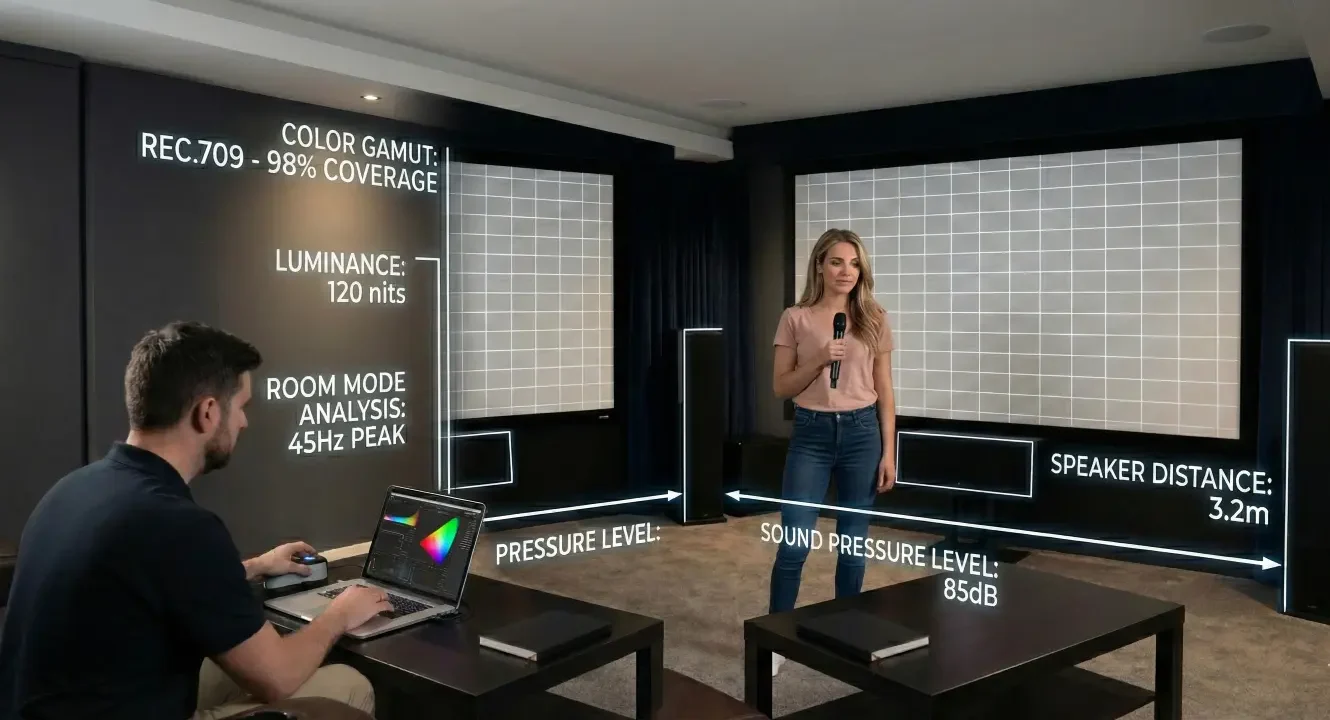
Room calibration is the process of measuring what your system is doing at your listening position(s) and then making adjustments so the system behaves more predictably in your room.
It’s helpful to think of calibration as: measurement → correction → verification.
Measurement basics (microphone, test tones, listening positions)
Most calibration workflows involve a measurement microphone and test tones (or sweeps). The system plays signals through your speakers and subwoofer(s), and the mic “hears” what your seat hears.
A key point many people miss: calibration isn’t measuring the speaker in isolation. It’s measuring the speaker + room combined.
Listening positions matter because small changes in mic position can reveal big differences in bass and clarity. That’s not a flaw in the process—it’s a reflection of how rooms behave.
What gets adjusted (levels, distance/delay, crossover, EQ target)
Without getting into brand-specific steps, calibration commonly sets or influences:
- Levels: balancing speaker outputs so one channel isn’t overpowering another (especially center dialogue vs mains).
- Distance/delay (timing): aligning when sound arrives so the system sounds coherent rather than smeared.
- Crossover behavior (integration): helping the speakers and subwoofer blend without a “hole” or a “hump” at the handoff point.
- EQ/tonal balance: shaping frequency response toward a more even, listenable result, based on a target curve or correction goal.
Done well, calibration can make the system feel less like a collection of separate speakers and more like one unified presentation—especially in the low end and the dialogue range.
Symptom triage: what calibration helps most (and what it won’t touch)
If you’re disappointed after an upgrade, start by identifying your symptoms. Different problems point to different priorities.
Dialogue clarity symptoms
Calibration often helps when:
- Voices are present but feel buried under music/effects
- Dialogue feels thin or nasal in your room
- You keep turning up the center channel and still don’t feel “locked-in” clarity
Calibration can improve balance and timing, and it can help correct tonal issues that make voices less intelligible. But if the room is very reflective (lots of hard surfaces), clarity problems may also be driven by reflections that EQ can’t fully erase.
Bass symptoms (boomy, uneven, “one-note”)
Calibration often helps when:
- Bass feels too loud but not tight
- Some notes jump out and others disappear
- Bass changes dramatically from one seat to another
It can smooth certain peaks, align timing, and help blend subwoofer and speakers. But it cannot fully solve a room that produces extreme variations between seats without addressing placement or strategy.
Imaging / envelopment symptoms
Calibration can help when:
- The soundstage feels off-center
- Surround effects don’t feel coherent
- The presentation collapses when you move slightly
Some of this is level/timing alignment. Some of it is speaker placement and room geometry. Calibration helps most when the foundation is reasonable and you’re polishing the result.
Turning it up is not a fix—often it’s the opposite
This is one of the most common traps after an upgrade.
If the tonal balance and timing are off, turning it up often makes the problems louder. Boomy bass gets boomier. Reflections get harsher. Dialogue gets more strained rather than clearer. The goal isn’t more volume—it’s a more controlled, balanced system that stays intelligible at normal listening levels.
The limits: why calibration can’t “fix bad physics”
Calibration is powerful, but it has limits. If you expect it to rewrite the room, you’ll be disappointed again.
When placement dominates the result
If a subwoofer is in a spot that heavily excites room boom, calibration may reduce some of it—but the room is still doing what the room does. Likewise, if speakers are tucked into furniture, jammed into corners, or blocked, calibration won’t restore what placement removed.
A practical way to say it: calibration can refine. It can’t undo a fundamentally compromised layout.
When reflections and decay overwhelm clarity
If you clap in the room and it sounds “live” or bright, you’re hearing what your dialogue is fighting.
Reflections and decay time can smear the definition of speech and the “edge” of transients. EQ can change tonal balance, but it doesn’t always fix the sense of confusion that comes from too much reflected energy arriving slightly late.
If dialogue is your pain point and your room is highly reflective, calibration may help—but you may also need a reflection strategy (which can be as simple as targeted treatment or layout choices).
When the room creates seat-to-seat inconsistency that EQ can’t solve fully
Bass is the classic example. Many rooms create spots where bass is strong and spots where it’s weak. Calibration can improve things at the measured position(s), but it may not make every seat identical—especially if the room is open-concept or irregular.
If you care about multiple seats (family movie nights), you usually need a plan that considers the whole seating area, not just one “perfect” chair.
Calibration vs acoustic treatment: how they work together (and when to choose what first)
People often argue about calibration vs treatment as if you must pick one. In reality, they solve different problems.
A simple decision logic is:
- Start with placement sanity
- Run calibration
- Treat what calibration can’t fix
- Recalibrate after changes
What treatment addresses that calibration doesn’t
Acoustic treatment can help with:
- Reflections that reduce clarity
- Decay and “ringing” that makes sound feel smeared
- A room that sounds too live or harsh
Calibration is mainly about how the system measures at the mic position(s). Treatment is about how the room behaves over time and how sound energy reflects and dissipates.
They’re complementary.
Treatment isn’t only for studios
This is the misconception that blocks a lot of homeowners.
You don’t need to turn your living room into a recording booth. Targeted, tasteful treatment—planned around aesthetics—can make a meaningful difference in clarity and comfort. The best high-end theaters don’t rely on calibration alone. They control the room and then calibrate the system to a better baseline.
Why bass is boomy in living rooms (and what to try before buying another sub)
Boomy bass in a living room is one of the most common “we upgraded and it still sounds wrong” complaints.
Placement and room interaction (corners, walls, open-concept quirks)
Bass interacts strongly with boundaries. Corners and walls can reinforce bass, sometimes creating a “one-note” effect. Open-concept spaces add complexity because bass can load differently depending on adjacent spaces and openings.
If you’ve only moved the sub a few inches and gave up, you may not have actually tested different behaviors. Some placements are dramatically better than others.
A practical approach before buying more gear:
- Identify whether boom is consistent everywhere or only in certain seats
- Try a few meaningfully different locations (not tiny shifts)
- Re-run calibration after changes, because the integration point may shift
Sub integration basics (crossover sanity, level matching)
Even with good placement, integration matters. If the sub is too hot, crossed oddly, or out of alignment with the speakers, you get “bass presence” without bass definition.
Calibration helps here because it can set levels and timing more consistently than tuning by ear. But you still want to listen critically after calibration, because “flat” doesn’t always equal “pleasant” in a real room.
When multiple subs can help (conceptually)
In some rooms, multiple subwoofers can help reduce seat-to-seat variation by distributing bass more evenly. This isn’t a guarantee and it’s not the first move for everyone—but it’s worth knowing that “more subs” isn’t only about louder bass. In the right plan, it can be about more consistent bass.
If you’re considering this path, it’s best approached as a system design decision—not an impulse purchase.
When to recalibrate (and why “set it once” often drifts)
A lot of homeowners run calibration once and never touch it again. Then they wonder why the system slowly stops feeling right.
Recalibration is worth considering when:
- You add or change speakers, a subwoofer, or amplification
- You move the subwoofer, even if it seems minor
- You rearrange furniture, rugs, seating, or add large objects
- You renovate, change flooring, or change the room’s surfaces
- Settings or firmware updates reset or alter system behavior
Calibration isn’t something you should obsess over weekly. But if the room changes, the sound can change. A quick recalibration can bring the system back into balance without endless manual tweaking.
Proof posture: how to know your calibration is “good”
A good calibration isn’t defined by a perfect graph you never see. It’s defined by the listening experience in your actual use.
Listening checks (categories, not specific scenes)
Use a few consistent tests:
- Dialogue-heavy content: voices should feel centered, intelligible, and stable without you riding the volume.
- Bass transitions: bass should feel present but not “detached” from the speakers. Notes should sound like different notes, not one booming tone.
- Dynamic scenes: loud moments should stay composed; clarity shouldn’t collapse as energy increases.
- Music with steady low end: bass should feel controlled and rhythmic, not bloated or slow.
If you notice that the system only sounds “good” at one exact volume level, that can indicate balance issues that still need refinement.
Consistency check: does it translate across seats?
If you have multiple seats, check them. A calibration that sounds great in one chair and falls apart two feet away may be optimized too narrowly or may be exposing a bass distribution problem.
A good home theater isn’t only about the “money seat.” It’s about enjoyable, predictable sound for the household.
What a pro brings (repeatable measurement, placement strategy, integration plan)
A professional calibration and optimization session typically adds value in three ways:
- Measurement that is repeatable and interpretable
- Placement strategy (especially for subwoofer integration and consistency)
- A plan that prioritizes changes (what matters now vs what’s optional later)
The goal isn’t to make your system “perfect.” It’s to make it coherent, controlled, and aligned with what you actually want: clear dialogue, tight bass, and a system that finally feels like it matches the investment.
Next steps: a practical order of operations for better sound
If you want a sensible path that avoids endless tinkering, use this order.
Phase 1: placement sanity + basic calibration
- Confirm speakers are reasonably placed (not blocked, not compromised)
- Put the subwoofer in a location that doesn’t obviously create boom in your primary seats (test a few real alternatives)
- Run calibration with care (mic placement and positions matter)
- Listen for obvious improvements and new problems
Phase 2: refine sub integration and dialogue clarity
- Adjust sub integration if bass still feels detached or boomy
- Address dialogue balance issues if voices still feel buried
- Re-run calibration after meaningful changes rather than chasing endless manual EQ tweaks
Phase 3: targeted acoustic treatment plan (if needed)
If clarity is still disappointing—especially in a reflective room—consider targeted treatment that fits your aesthetics and room use. Treatment can improve the baseline so calibration has a better foundation to work with.
The key is to stop buying gear blindly. Most disappointing upgrades aren’t solved by “better speakers.” They’re solved by better integration.
Book a calibration + room optimization consult (so the system matches the investment)
Upgraded speakers but the sound still isn’t clicking? AVI Group can measure your room, calibrate your system, and help you prioritize the changes that actually improve dialogue and bass.
Send a few room photos, your gear list, your seating layout, and the specific pain points you’re hearing. We’ll recommend the next best step—so you can stop chasing settings and start enjoying the system.
FAQ content
1) What is room correction and calibration?
Room correction and calibration is the process of measuring how your speakers and subwoofer behave in your room and then adjusting levels, timing, and tonal balance to improve clarity and consistency. It’s designed to align the system to your actual space rather than an idealized environment.
2) Does calibration fix bad speakers?
Calibration can improve balance and integration, but it can’t turn poor-quality speakers into great ones or fix fundamental limitations. In many cases, “bad sound” after an upgrade isn’t bad speakers—it’s how the room and placement affect what you hear.
3) How often should you calibrate a home theater?
There’s no strict schedule. Recalibrate after meaningful changes: moving a subwoofer, adding speakers, changing seating, large furniture, rugs, or renovations. If the system starts sounding “off” again, a recalibration is often a faster reset than endless manual tweaking.
4) What’s the difference between calibration and acoustic treatment?
Calibration adjusts how your system behaves at the listening position(s) using measurement and correction (levels, timing, tonal balance). Acoustic treatment changes how the room behaves by reducing reflections and improving decay characteristics. They solve different problems and often work best together.
5) Why is bass boomy in my living room even with good speakers?
Boomy bass is often related to how the subwoofer interacts with the room—placement near boundaries, room shape, and open-concept layouts can create peaks and uneven response. Calibration can help, but placement and integration are usually the first priorities.
6) Can room calibration improve dialogue clarity?
Often, yes. Calibration can improve dialogue by balancing channel levels, aligning timing, and correcting tonal issues that make voices sound thin or buried. If the room is very reflective, you may also need a reflection strategy to fully restore clarity.
Book a Calibration + Room Optimization Consult with AVI Group.
Upgraded speakers but the sound still isn’t clicking? AVI Group can measure your room, calibrate your system, and help you prioritize the changes that actually improve dialogue and bass. Send a few room photos and your gear list—we’ll recommend the next best step, not just more equipment.
RELATED LINK: