
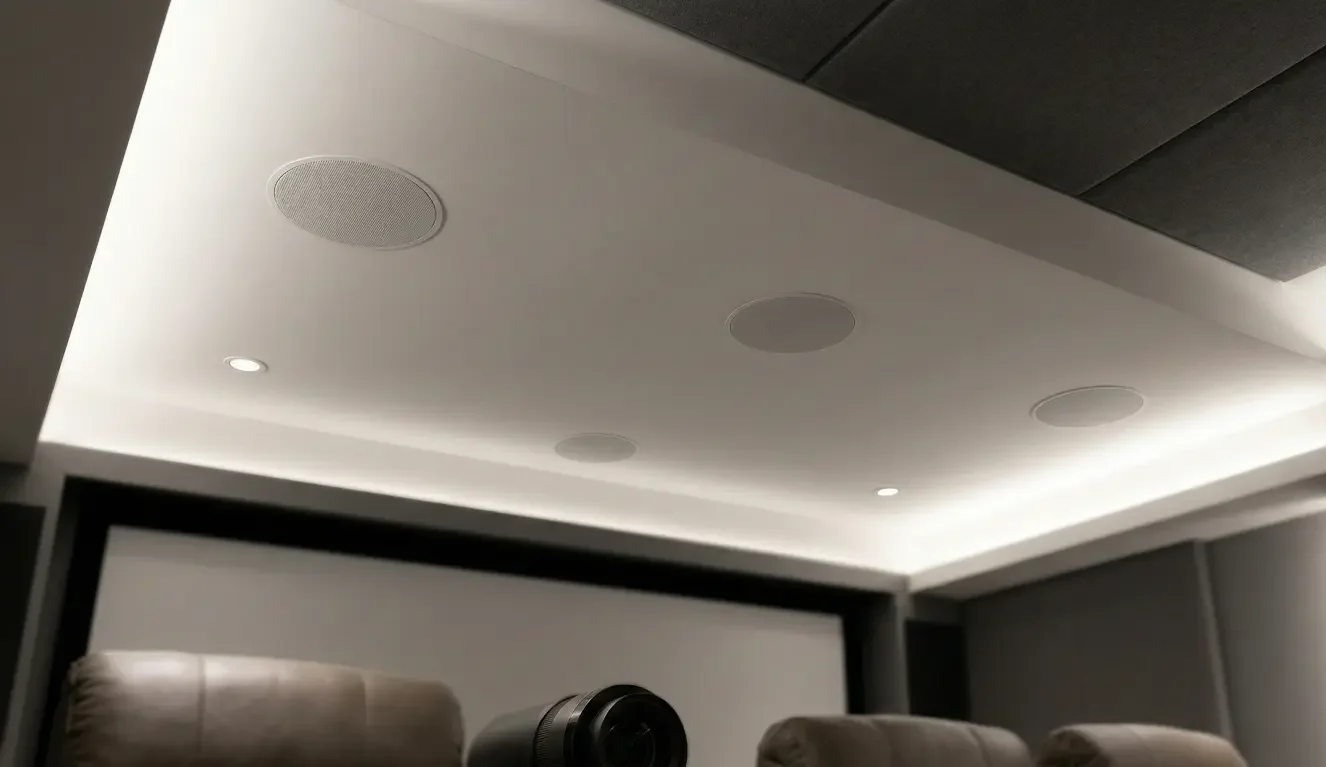
“Let’s keep everything invisible” is a beautiful design direction—until the client adds, almost as an afterthought, “And I want the living room to feel like a theater.”
That’s where in-ceiling speakers can either be your cleanest win or your quietest regret.
In the right spaces, in-ceiling speakers are one of the most elegant tools in residential audio: they disappear into the ceiling plane, they can distribute sound evenly for entertaining, and they keep walls free for art, glazing, millwork, and furniture. In the wrong spaces, they create the exact complaint you want to avoid: “Why does it sound like the voices are coming from above me?”
This decision guide is written for interior designers who need a spec-ready way to choose. No brand pushing. No “best speaker” lists. Just clear use cases, the expectation gap to address early, and the coordination points that protect your ceiling plan from last-minute compromises.
In Ceiling Speakers Use Cases When They Work and when they Disappoint.
The real question: are you designing “invisible background audio” or “a room that performs for TV”?
Most client disappointment starts with a vocabulary problem.
Clients often conflate three ideas:
- Hidden (no visible speakers)
- High-end (premium home experience)
- Cinematic (clear dialogue, strong front soundstage, impact)
Those don’t always travel together.
A simple, plain-English distinction helps you set expectations without sounding technical:
- Background listening is “music that makes the home feel alive.” It supports entertaining, cooking, walking through the house, and daily living. It doesn’t require a single perfect seat.
- Critical listening is “I want it to sound right.” It’s about clarity, direction, and realism—especially for TV dialogue and movie soundtracks. Seating matters, and the sound should feel anchored to the screen.
If the client’s priority is “clean ceilings” and their listening is mostly background, in-ceiling speakers can be a great answer.
If the client says “theater-level,” treat that as critical listening until proven otherwise. That’s the decision moment.
When in-ceiling speakers are a great choice (clean wins with minimal regret)
If you want in-ceiling speakers to feel like a premium design move—not a compromise—aim them at spaces where the goal is even coverage and a calm experience.
These are the classic in ceiling speakers use cases that tend to hold up well over time:
Whole-home audio zones that benefit from even coverage
In-ceiling speakers are often a strong fit for:
- Kitchens
- Open kitchen + dining
- Hallways and transitional areas
- Bedrooms
- Casual lounges and family spaces used for conversation
- Bathrooms (where wall space is limited and the goal is ambiance)
In these rooms, clients usually want music “present” rather than “pinpoint accurate.” In-ceiling supports that. It fills the space without demanding a perfect listening position.
Entertaining spaces where “everyone hears it” matters more than “one seat sounds perfect”
A common design win is a great room where the client hosts and moves around: conversation at the island, drinks at the dining table, kids moving through the space. A wall-based stereo setup may sound better from one direction, but in-ceiling can provide more uniform coverage throughout the zone.
The key is expectation: it’s premium background audio that feels integrated into the home, not a theater system disguised as a ceiling grille.
Layouts where ceilings simply work better than walls
Sometimes walls are a non-option:
- Floor-to-ceiling glass
- Feature walls with stone, plaster, or millwork
- Art walls where you don’t want visible speakers
- Furniture plans that leave no good speaker location
In-ceiling can be the most design-respectful solution. In those cases, it’s not “choosing ceiling speakers”—it’s choosing a speaker location that doesn’t fight the architecture.
When in-ceiling speakers are a bad choice (or need a different plan)
There are rooms where ceiling speakers can work, but only if you’re honest about what they won’t deliver. And there are rooms where they’re simply the wrong tool if the client expects cinematic performance.
TV-first rooms where dialogue clarity and “sound from the screen” matters
If the space is designed around watching TV—living room, primary lounge, media area—clients care about:
- Dialogue clarity
- The sense that voices come from the screen
- A stable front soundstage (left/center/right)
In-ceiling speakers struggle here because the sound is coming from above while the picture is in front. Even if it’s loud, it can feel disconnected.
That’s when you get the complaint: “It’s clear, but it doesn’t feel right.”
Very high or sloped ceilings, or unpredictable seating
If the ceiling height is tall, vaulted, or sloped, a “standard” ceiling layout may not translate the way clients expect. The speaker-to-listener distance increases, and coverage becomes harder to shape.
If seating is unpredictable—sectionals rotate, chairs move, the TV wall isn’t fixed—ceiling placement decisions become riskier. The more “floating” the furniture plan, the more you need a system that anchors sound to the screen rather than to the ceiling plane.
Rooms where you need precise stereo imaging or “front-stage” realism
If the client loves music in a focused way—sitting, listening, caring about direction and realism—ceiling speakers are rarely the best primary solution. They can play music beautifully as ambiance, but “stereo imaging” and “front-stage realism” are usually goals better served by speakers that create a soundstage in front of the listener.
A helpful designer translation is: “If you want the sound to feel like it’s in front of you—not above you—ceiling speakers are usually not the lead actor.”
The TV question: “Are in-ceiling speakers good for TV?” (what to say to clients)
This is the exact moment where you can save a project from regret.
The honest answer: in-ceiling speakers can be acceptable for casual TV, but they’re rarely the best solution if the client expects theater-level performance.
The core limitation: sound comes from above, screen is in front
TV watching is visual-first. Your brain expects voices to originate where faces are—on the screen.
When the main speakers are overhead, the audio can feel “lifted” away from the screen. It may still be loud and detailed, but the direction feels wrong. Clients often describe it as “the sound is floating” or “it’s coming from the ceiling.”
What happens to dialogue perception when the center channel is overhead (simple explanation)
You don’t need to teach psychoacoustics. You can say it like this:
“When the main dialogue comes from above instead of near the TV, it can be harder to feel like voices are anchored to the screen—especially at normal listening levels.”
That’s usually enough for a client to understand the tradeoff without feeling corrected.
Decision rule: what the client must prioritize (invisible vs cinematic)
Here’s a clean decision rule you can use:
- If the client’s top priority is invisible, then in-ceiling can work—but you should frame it as a design-forward compromise for TV performance.
- If the client’s top priority is cinematic, then the system needs a front-stage plan that supports screen-based audio. You can still keep the room clean—just with a different strategy than “everything in the ceiling.”
A short mini-script you can borrow:
“We can absolutely keep the ceiling clean. The only question is whether you want ‘great background sound’ or ‘theater-level TV sound.’ If theater-level is the goal, we should plan for audio that’s anchored to the screen and use the ceiling for support—not as the main source.”
Placement realities designers should know (so the ceiling plan doesn’t paint you into a corner)
In-ceiling audio fails most often because the speaker layout is treated like recessed lighting: evenly spaced, centered, and decided late.
Speakers are not downlights. They interact with seating, room volume, and where people actually spend time.
Here are the placement issues that commonly cause regret:
- Speakers placed without reference to the seating plan
- Too close to walls or corners (creating uneven coverage)
- Placed where lighting, HVAC registers, beams, or ceiling details force awkward compromises
- “Symmetry” prioritized over real listening zones (especially in open kitchens)
Even if you’re not drawing an audio plan, knowing what to watch for helps you protect the reflected ceiling plan.
Ceiling height and room volume: why “same layout” doesn’t scale
Designers often inherit a “standard” pattern: two speakers here, two speakers there, evenly spaced.
But ceiling height changes the experience. The higher the ceiling and the larger the volume, the harder it is to achieve clarity and even coverage with a cookie-cutter layout. The same spacing that works in an 8–9 ft ceiling can feel thin or diffuse in a tall great room.
A practical coordination approach:
- Treat tall ceilings as their own case.
- Confirm the speaker layout after the furniture plan is stable.
- Make sure the AV team knows which seating positions and zones matter most.
Open kitchen placement: avoiding “hot spots” over islands and dead zones at dining
Open kitchens are one of the best reasons to use ceiling speakers—and one of the easiest places to place them wrong.
Two common failure modes:
- Hot spots over the island (too loud where people stand, weak elsewhere)
- Dead zones at dining (music fades right where guests sit)
The fix is rarely “add more speakers.” It’s deciding what the zone is supposed to do:
- Is the priority the island, the dining table, or the entire open area?
- Should the kitchen and dining be one zone or two?
- Where do you want the “center of gravity” of sound to be?
These are design questions as much as audio questions. When they’re answered early, the ceiling plan stays clean and intentional.
In-ceiling vs soundbar: the honest tradeoff (and when a hybrid wins)
Clients often arrive with one of two assumptions:
- “We’ll do in-ceiling speakers and skip the soundbar.”
- “We’ll do a soundbar for TV and ceiling speakers for surround.”
Both can work—but both can also create a confusing system if roles aren’t defined.
In-ceiling as the primary TV system: what you gain and what you give up
Pros
- Clean aesthetic
- No visible speakers near the TV
- Even coverage for casual listening
Cons
- Dialogue can feel disconnected from the screen
- The room may lack the “front-stage” impact clients expect
- The experience can feel less cinematic even at high quality
If the client is mostly watching news, sports, or casual TV, they may accept this tradeoff. If they say “movies,” “theater,” or “immersive,” treat that as a warning sign.
Soundbar as the TV anchor: where it wins
A soundbar is often chosen because it’s visually simple and placed near the screen—exactly where TV audio needs to feel anchored.
For many living rooms, it’s a practical aesthetic-performance compromise:
- Cleaner than a full speaker system
- More screen-anchored than ceiling speakers alone
- Often easier to explain to clients
When a hybrid wins (and how to avoid confusion)
A hybrid approach can work when each element has a defined job:
- Soundbar (or screen-anchored audio) handles TV dialogue and front-stage presence.
- In-ceiling speakers provide ambient fill in open areas or support whole-home music zones.
Where hybrids fail is when the system tries to make ceiling speakers do the “front stage” while the soundbar also tries to do the same job. That’s when clients say, “It sounds weird” without knowing why.
A simple coordination rule:
If you use both, make sure the AV team defines which source is primary for TV and how the ceiling speakers are used—support, not competition.
The misconception reversal: “If it’s expensive and hidden, it must be theater-grade”
This is the misconception that causes the most expensive disappointments.
Invisible tech can be premium. But “premium” doesn’t automatically mean “theater-grade.” A theater experience is about how the soundstage is constructed—where sound originates, how it moves, and how it relates to the screen.
That’s why the best theater rooms are rarely “all in-ceiling.”
Even in premium projects, designers and integrators typically avoid making the ceiling the main source of screen-based audio. They keep the room clean, yes—but they still respect how humans perceive TV sound.
How premium projects handle aesthetics without sacrificing performance (conceptual, no brands):
- They plan the TV wall and seating first, then build the audio plan around it.
- They treat ceilings as a support layer, not the main actor, when TV is the priority.
- They coordinate early so there’s no visible retrofit later.
The takeaway is not “never use ceiling speakers.” It’s: don’t let “invisible” become the only requirement when the client’s expectation is cinematic.
The spec-ready checklist: what to decide before drywall and paint
If you want to avoid patched ceilings and last-minute compromises, the most valuable thing you can do is lock the key decisions before rough-in and drywall.
Here’s the checklist that makes in-ceiling speakers behave like a design tool instead of a gamble.
What the AV team needs from design
- Reflected ceiling plan (including lighting, beams, soffits, HVAC locations)
- Furniture plan and primary seating positions
- TV location and mounting details (including fireplace constraints if applicable)
- Ceiling heights and any sloped/vaulted geometry
- Room function priorities (entertaining, TV-first, music-first, mixed-use)
What the designer needs from the AV team
- Speaker location plan (with clearances from lighting/HVAC features)
- Confirmation of which speakers are intended for background vs TV performance
- Zone plan (what areas are grouped together and why)
- Access and service considerations (especially with architectural ceiling details)
- A control approach that won’t confuse the client
What “done” looks like
You’re looking for three outcomes:
- The client’s expectation is aligned to the system’s role (no surprise disappointment).
- The ceiling plan supports both design and performance (no conflict with lighting/HVAC).
- The plan is documented clearly enough that rough-in is clean and repeatable.
If any of these are missing, that’s where projects tend to drift into late-stage compromises.
Next steps: the low-friction path to a clean ceiling and happy ears
If the project is still early, you’re in the best position possible. The cleanest audio outcomes happen when the designer and integrator collaborate before drywall—not after.
When to bring in an integrator (timing)
- As soon as the room function and furniture plan are reasonably stable
- Before speaker rough-in locations are “locked” by electrical decisions
- Before ceiling details make speaker placement inflexible
What to request
Ask for a process that protects your design:
- A concept layout tied to seating and TV location
- A clear expectations conversation (background vs TV performance)
- A rough-in plan that coordinates with your reflected ceiling plan
If your client wants clean ceilings and expects great TV sound, the right plan starts before drywall.
We’ll review the room’s use case, seating, ceiling plan, and TV location—then map speaker locations that respect the design and the listening experience.
Schedule a consultation and we’ll give you a spec-ready direction you can coordinate with the builder and trades.
FAQ content
Are in-ceiling speakers good for TV in a living room?
They can be acceptable for casual TV, especially when the priority is a clean aesthetic. But if the client expects theater-level sound, in-ceiling speakers as the main TV system often disappoint because dialogue and key sound cues may feel like they come from above rather than from the screen area.
When should you avoid in-ceiling speakers entirely?
Avoid making in-ceiling speakers the primary solution in TV-first rooms where dialogue clarity and screen-anchored sound are a priority, and in spaces where ceiling height, slopes, or unpredictable seating make it hard to create a consistent listening experience. They may also be a poor primary choice for clients who want precise stereo imaging for music.
What’s the best placement for ceiling speakers in an open kitchen?
Placement depends on what the zone is supposed to do. The best outcomes come from planning around where people spend time (island, prep areas, dining) and coordinating with lighting and HVAC locations so speakers don’t end up creating loud “hot spots” in one area and weak coverage in another. Confirm final locations with the AV team before rough-in.
Can in-ceiling speakers replace a soundbar?
Sometimes, but it depends on expectations. For casual TV, in-ceiling speakers may work. For screen-anchored dialogue and a more cinematic feel, a soundbar (or another front-stage approach) often performs better because it’s located near the TV.
Do high ceilings make in-ceiling speakers sound worse?
High ceilings can make it harder to achieve the same clarity and even coverage you’d get in a standard-height room. The solution isn’t always “more speakers”—it’s designing placement and the system’s role around room volume, seating, and how the space is used.
In-ceiling speakers vs soundbar: which is better for clean design?
Both can support a clean design, but they solve different problems. In-ceiling speakers are excellent for invisible background audio across a home. A soundbar is often better for TV clarity because it anchors sound to the screen. The best choice depends on whether the room is music/entertaining-first or TV-first.
Schedule a design-forward audio consultation (align aesthetics + performance before rough-in).
If your client wants clean ceilings and expects great TV sound, the right plan starts before drywall.
We’ll review the room’s use case, seating, ceiling plan, and TV location—then map speaker locations that respect the design and the listening experience.
Schedule a consultation and we’ll give you a spec-ready direction you can coordinate with the builder and trades.