
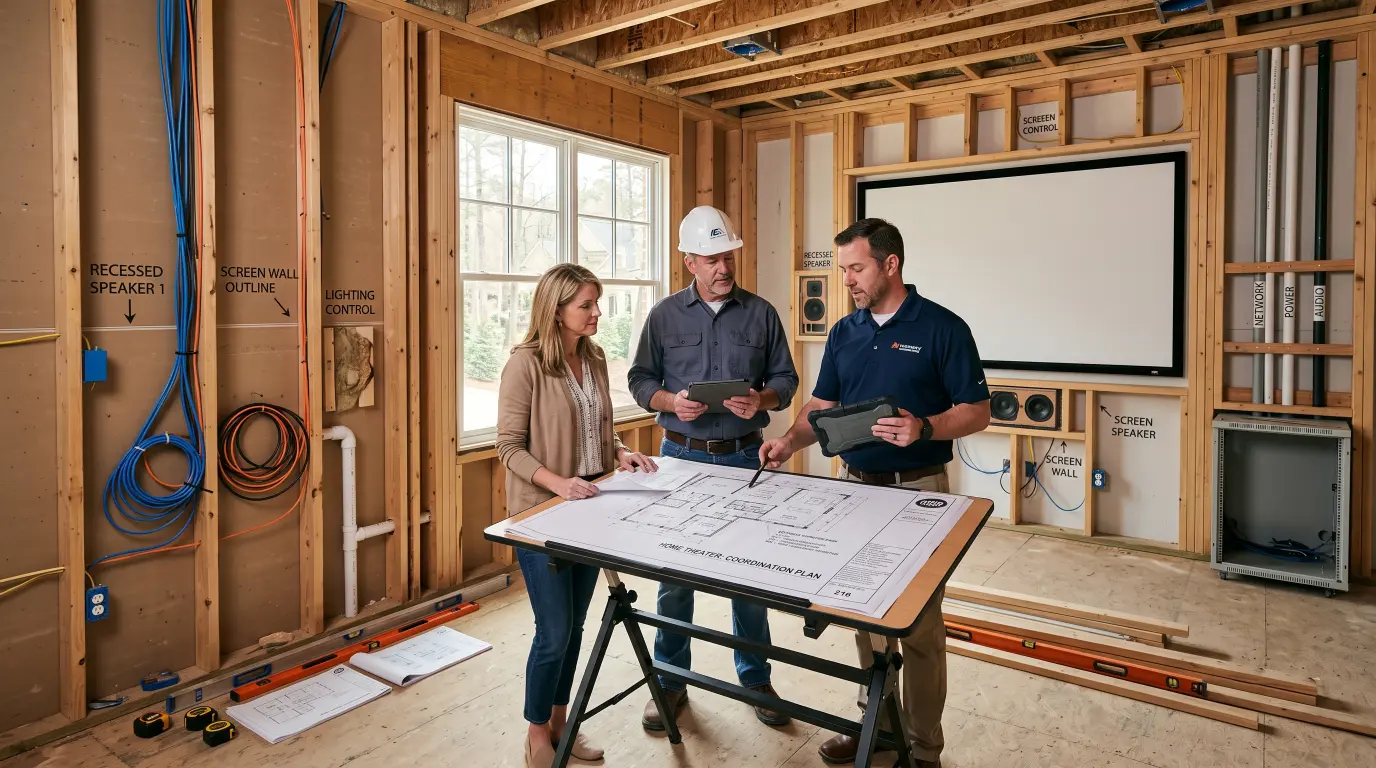
A home theater can look simple on the surface: a screen, speakers, seating, lighting, and a few components hidden in a cabinet. But the decisions that make a theater perform well are often made long before the room looks finished. Once drywall is up, built-ins are installed, flooring is complete, and furniture is ordered, small planning mistakes can become expensive corrections.
That is why home theater installation should be planned early in a renovation or custom build. Wiring paths, speaker locations, equipment ventilation, network reliability, lighting control, acoustics, and seating layout are much easier to solve before walls are closed. Waiting until the room is nearly complete can limit options, increase labor, and force compromises that were avoidable.
AVI Group helps Atlanta-area homeowners, builders, architects, and designers create custom AV, home theater, and smart home systems that blend performance, usability, and aesthetics. This guide explains the home theater installation mistakes that are expensive to fix later, especially when AV decisions are delayed during a remodel.
Mistake 1: Waiting Until After Drywall to Think About AV
One of the most expensive home theater mistakes during renovation is treating AV as a finishing detail. A theater is not just decor. It depends on infrastructure hidden inside the walls, ceiling, floors, racks, and network cabinet.
Before drywall, the team can plan speaker wire, conduit, low-voltage cable, power locations, projector paths, display support, network wiring, subwoofer locations, lighting control, and equipment placement. After drywall, many of those changes require cutting, patching, repainting, or working around finished surfaces.
The earlier the AV integrator is involved, the easier it is to coordinate with the builder, electrician, designer, and homeowner before expensive rework becomes necessary.
Mistake 2: Skipping a Real Design Plan
A strong home theater starts with a design plan, not a shopping list. Buying a projector, screen, receiver, and speakers before the room is planned can lead to mismatched equipment, awkward placement, and performance limitations.
A real plan considers room dimensions, ceiling height, screen size, viewing distance, seating rows, speaker layout, acoustic treatments, lighting, equipment location, control systems, and how the space will be used. A family movie room, dedicated theater, sports room, media lounge, and multipurpose basement all need different decisions.
Custom home theater planning mistakes are expensive because the visible parts of the room may need to change later to support the system the homeowner actually wanted.
Mistake 3: Poor Speaker Placement
Speaker placement has a major effect on the theater experience. If speakers are placed only where they are easiest to install, the room may never sound right. Dialogue may feel disconnected from the screen. Surround effects may be uneven. Bass may feel boomy in one seat and weak in another.
Speaker locations should be planned around the seating layout, screen position, room shape, and desired audio format. In-wall and in-ceiling speakers are especially important to plan before drywall because moving them later can be disruptive.
The mistake is not simply choosing the wrong speaker. It is failing to coordinate speaker placement with the room before construction decisions become permanent.
Mistake 4: Forgetting About Subwoofer Locations
Subwoofers are often added as an afterthought, but bass performance depends heavily on room behavior and placement. A subwoofer shoved into the only available corner may not create smooth, balanced bass across the seating area.
Planning subwoofer locations early gives the integrator more flexibility. Some rooms benefit from multiple subwoofers. Others need specific wiring paths, outlet locations, or built-in accommodations. If the room is already finished, those changes may become difficult or visually awkward.
A theater that looks beautiful but has uneven bass can feel disappointing even with high-quality equipment.
Mistake 5: Not Running Enough Wire or Conduit
Home theater wiring mistakes are some of the most painful to fix later. Homeowners sometimes run only the wires needed for the equipment they plan to buy today. Then technology changes, the seating plan changes, or the family wants upgrades later.
Conduit can protect flexibility. Extra pathways for HDMI, fiber, speaker wire, network cable, control wire, or future upgrades can be far less expensive during construction than after the room is finished.
Good prewire planning should account for the current system and reasonable future needs. The goal is not to overbuild blindly. The goal is to avoid locking the room into a limited setup.
Mistake 6: Placing Equipment Without Ventilation
AV equipment generates heat. Receivers, amplifiers, streaming devices, gaming systems, power conditioners, network equipment, and control processors all need proper ventilation. A beautiful cabinet that traps heat can shorten equipment life and create reliability problems.
Equipment locations should be planned around airflow, service access, cable management, power, network connections, and noise. If the equipment rack is hidden in a closet, that closet still needs to function as an equipment space.
Ventilation is much easier to design before cabinetry, built-ins, and closets are finalized.
Mistake 7: Ignoring Network Requirements
Modern home theaters rely on strong networks. Streaming, control apps, automation, updates, security, gaming, music services, and smart home integration all depend on reliable connectivity.
A weak Wi-Fi signal or overloaded network can make a premium theater feel unreliable. Hardwired network connections are often better for key equipment, especially streamers, control systems, gaming consoles, and networked AV devices.
Network planning should happen with the AV plan, not after the homeowner discovers buffering, app delays, or control issues.
Mistake 8: Choosing Screen Size Without Seating Math
A bigger screen is not always better. Screen size should be matched to viewing distance, room layout, projector or display type, sightlines, and seating rows. If the screen is too large, viewers may feel eye strain or need to move their heads constantly. If it is too small, the theater may not feel immersive.
Screen height also matters. A screen mounted too high can be uncomfortable. A screen mounted without considering the front speakers, cabinetry, fireplace, or sightlines can create design conflicts.
Before framing or built-ins are finalized, the team should confirm screen size and viewing geometry.
Mistake 9: Designing Lighting Too Late
Lighting can make or break the theater experience. A room with uncontrolled glare, bright recessed lights over the screen, or no dimming scenes may never feel cinematic. Lighting should be planned around viewing, cleaning, entertaining, and safe movement.
Good theater lighting may include dimmable zones, step lights, sconces, accent lighting, motorized shades, and one-tap scenes. It should also avoid reflections on the screen and give users simple control.
When lighting is designed after the room is built, the result is often a compromise between what looks good and what performs well.
Mistake 10: Ignoring Acoustics Until the Room Sounds Bad
A finished room can look perfect and still sound harsh, echo-filled, or muddy. Hard floors, glass, drywall, large windows, and open spaces can create acoustic problems that equipment alone cannot fix.
Acoustic planning does not always mean turning the room into a recording studio. It means thinking about surfaces, reflection points, seating, speaker placement, bass behavior, and treatments that can fit the design.
Acoustics are easier to address when the AV integrator and designer coordinate early. Waiting until the room sounds bad may limit where treatments can go.
Mistake 11: Forgetting Control Simplicity
A theater should be easy to use. If the homeowner needs four remotes, three apps, and a printed instruction sheet, the system may feel frustrating even if the components are excellent.
Control planning should include the display, audio, sources, lighting, shades, climate, and scenes where appropriate. The goal is one simple experience: watch a movie, stream music, lower shades, dim lights, or turn everything off without confusion.
AVI Group’s broader smart home and automation capabilities are relevant here because a theater often performs best when it works as part of the home, not as an isolated pile of devices.
Mistake 12: Not Coordinating With Builders and Designers
Home theater installation before drywall requires coordination. Builders need to know where wiring runs. Electricians need to know power needs. Designers need to know where speakers, screens, shades, racks, and touch panels may appear. Cabinetmakers need equipment dimensions and ventilation requirements.
If those decisions happen separately, conflicts appear late. A speaker may land behind millwork. A projector throw distance may not work. A rack may not fit. A light fixture may reflect on the screen. A finished ceiling may block the best speaker location.
Early collaboration protects both design and performance.
Mistake 13: Underestimating Power Needs
A home theater may need dedicated power planning for AV equipment, projector or display, powered seating, subwoofers, network gear, lighting control, shades, gaming equipment, and future devices. Poor power planning can lead to cluttered extension cords, inconvenient outlets, and equipment reliability issues.
Power should be coordinated with the AV plan and electrical team. Outlet placement, surge protection, rack power, and access should be discussed before walls and cabinetry are finished.
A clean theater depends on power being where it needs to be, not where it happened to be easiest to place.
Mistake 14: Choosing Equipment Before Defining the Experience
It is easy to get distracted by products. But the better starting point is the experience. Will the room be used for movies, sports, gaming, music, entertaining, or all of the above? How many people will use it? Should it disappear into the design or feel like a dedicated cinema?
Once the experience is clear, the equipment can be selected to support it. Without that clarity, homeowners may overspend on the wrong features or underspend on the parts that matter most.
A custom AV plan helps translate lifestyle goals into technical decisions.
Mistake 15: Not Planning for Service Access
Even well-installed AV systems may need service, upgrades, troubleshooting, firmware updates, or component replacement. If equipment is buried behind finished millwork or mounted without access, future service becomes harder and more expensive.
Service access should be part of the design. Racks, panels, wiring, labels, ventilation, and documentation all matter. A clean installation is not only about how the room looks on day one. It is also about how well the system can be maintained.
Planning for service protects the homeowner’s investment over time.
What to Plan Before Drywall
Before drywall, homeowners should resolve the big infrastructure questions. Where will the screen or display go? Where will each seat be? Where will speakers and subwoofers be located? What wiring and conduit are needed? Where will equipment live? How will the network support the room? What lighting scenes are needed?
This is also the time to coordinate power, ventilation, control, shades, acoustics, and future upgrade paths. It may feel early, but it is exactly when decisions are least expensive to change.
If the remodel is already underway and AV decisions have been delayed, the best next step is to involve an integrator before more surfaces are closed or finished.
How AVI Group Helps Prevent Expensive Theater Mistakes
AVI Group designs and installs custom home theaters, whole-home audio, smart home automation, lighting, shades, networking, security, outdoor entertainment, golf simulator rooms, and commercial AV systems for Atlanta-area homeowners and businesses.
For home theater projects, AVI Group can help homeowners, builders, architects, and designers make key decisions early: wiring, equipment location, speaker placement, screen planning, lighting control, acoustics, networking, and control simplicity. The goal is a theater that performs well, looks intentional, and is easy to use.
AVI Group does not publish one-size-fits-all pricing because each project depends on the room, goals, equipment, design requirements, and installation scope. A free consultation is the right starting point for understanding what your space needs before costly rework becomes part of the project.
Home Theater Planning Checklist
Use this checklist before drywall or major finishes are complete:
- Confirm the room’s main purpose: movies, sports, gaming, music, or multipurpose use.
- Plan screen size, viewing distance, and seating layout together.
- Place speakers and subwoofers based on the seating plan.
- Run the right wiring and conduit before walls are closed.
- Plan equipment location, ventilation, power, and service access.
- Include hardwired network connections for key devices.
- Coordinate lighting zones, dimming, scenes, and shade control.
- Consider acoustics before the room is fully finished.
- Confirm control simplicity so the system is easy to use.
- Coordinate AV plans with the builder, electrician, designer, and cabinetmaker.
- Leave room for future upgrades where practical.
- Schedule an AV consultation before construction decisions become expensive to change.
Final Thoughts
The most expensive home theater installation mistakes usually happen early, even if they are not visible until later. Wiring, layout, lighting, acoustics, network, equipment location, and control decisions all affect the final experience.
If your remodel is underway and AV decisions have been delayed, do not wait until the room is finished to ask what is possible. The earlier the system is planned, the more options you have and the easier it is to protect the design.
AVI Group can help Atlanta-area homeowners plan a custom home theater before hidden mistakes become costly corrections.
FAQ
When should I plan home theater installation during a remodel?
Plan the home theater before drywall whenever possible. Wiring, conduit, speaker locations, power, equipment placement, lighting, and networking are easier and less disruptive to coordinate before walls and finishes are complete.
What are the most common home theater wiring mistakes?
Common wiring mistakes include running too few cables, skipping conduit, placing wires in the wrong locations, forgetting subwoofer wiring, failing to hardwire network connections, and not planning for future upgrades.
Can a home theater be installed after the room is finished?
Yes, but options may be more limited and installation may require more compromise. Finished walls, ceilings, cabinetry, and flooring can make wiring, speaker placement, and equipment changes more expensive.
Why is speaker placement important in a home theater?
Speaker placement affects dialogue clarity, surround effects, bass balance, and the overall sense of immersion. Placement should be coordinated with seating, screen size, room shape, and the desired audio format.
How can AVI Group help with custom home theater planning?
AVI Group can help plan the system before construction decisions are finalized, including wiring, speakers, screen size, lighting control, acoustics, networking, equipment location, and easy-to-use automation.
RELATED LINK: