
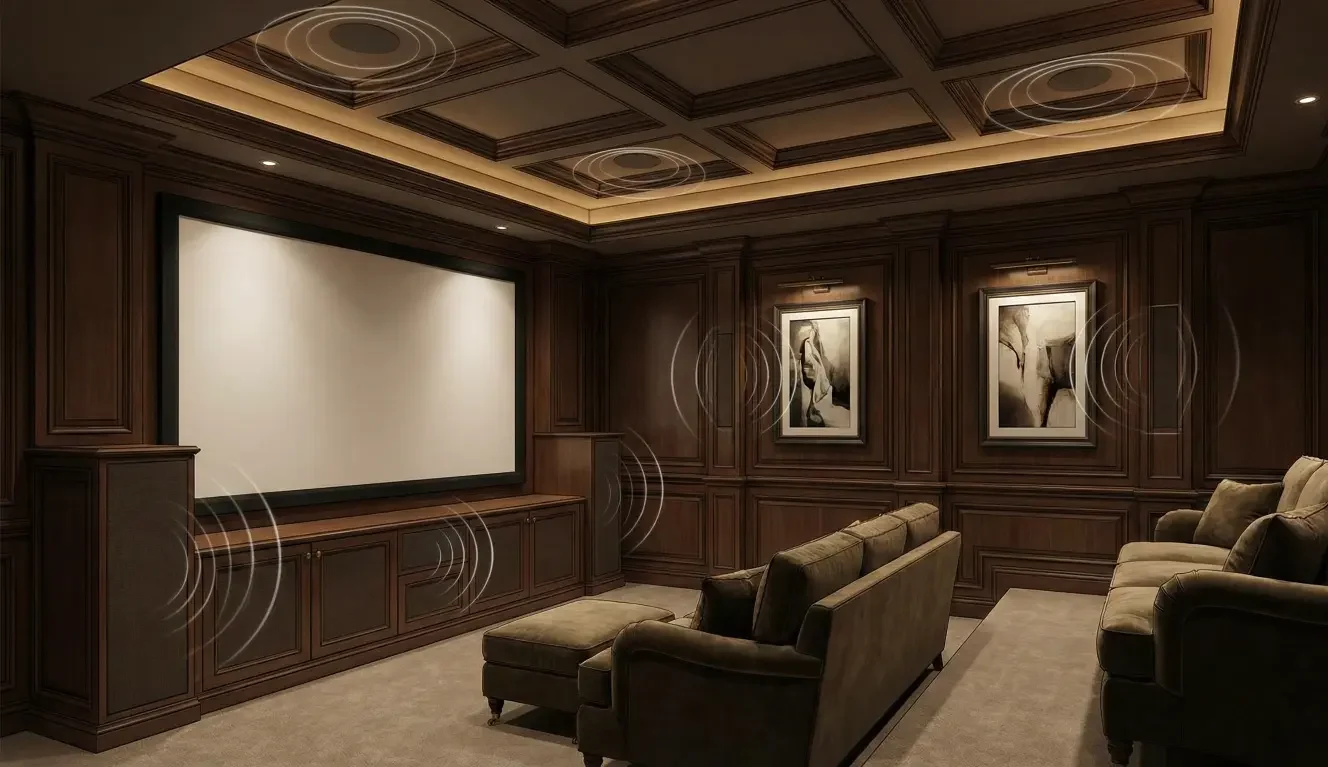
The client points to a pristine rendering and says, “No speakers anywhere.”
So how do we hide speakers without sacrificing sound quality?
If you’re leading interior design on a luxury project, you’ve heard some version of that line. You want the room to feel calm and intentional, not like a showroom for electronics. At the same time, you don’t want the finished space to sound thin, harsh, or oddly disconnected from the TV wall—especially when the client’s expectations are high and the build schedule is tight.
This is where a little decision logic helps. “Hidden speakers” isn’t one solution. It’s a set of choices with real tradeoffs—some great, some risky—depending on how the room will actually be used.
Below is a designer-friendly guide to hide speakers without ruining sound quality, with practical placement rules, finish considerations, and coordination steps that protect the aesthetic you’re building.
The real goal isn’t “no speakers,” it’s “no visual clutter”
Most clients don’t truly care whether a speaker exists. They care that technology doesn’t interrupt the design story.
In practice, “no visible speakers” usually means one of these:
- No bulky boxes on surfaces or stands
- No visual noise on the TV wall or feature wall
- No mismatch between grills, textures, and finishes
- No “afterthought” add-ons once the room is furnished
The quickest way to keep both the look and the sound is to define what “invisible” needs to be in this specific room:
- Is this room TV-first (dialogue clarity matters most)?
- Music-first (tone, imaging, and even coverage)?
- Entertaining-first (consistent volume across zones)?
- A hybrid (the most common, and the easiest to accidentally compromise)?
If you can answer that, you can choose the concealment approach that makes the most sense—and avoid “invisible” choices that quietly degrade the experience.
Your decision map: pick the concealment approach that matches the room
When a client wants “no visible speakers,” the temptation is to pick the most hidden option and assume the sound can be “fixed later.” That’s usually the wrong order.
A better approach is to choose the least-compromise concealment strategy for the room’s purpose.
If the room is TV-first: prioritize dialogue clarity and front-stage alignment
TV-first spaces live or die on intelligibility. If voices feel like they’re coming from the ceiling or drifting away from the screen, clients notice—even if they can’t explain why.
In these rooms, your best results usually come from keeping the main sound anchored near the display wall. That doesn’t require visible boxes, but it does usually require intentional placement.
If the room is music-first or entertaining: prioritize coverage and evenness
Music and entertaining are less about “pinpoint” sound at the TV and more about the room feeling evenly filled. A solution that’s “perfect” for a sofa-centered TV setup can feel uneven when people are moving around.
Here, the concealment strategy should support consistent coverage across the zones the client uses—kitchen-to-living, living-to-patio, bar-to-lounge, and so on.
If the room is open-concept: plan zones and accept compromises intentionally
Open-concept great rooms are where hidden-speaker decisions go sideways. The room may have:
- A TV wall on one end
- A kitchen and dining zone off to the side
- Tall ceilings or hard surfaces
- Multiple seating orientations
In these rooms, you often need a hybrid approach: one strategy for TV clarity near the display, another for ambient coverage elsewhere. The goal is not “the same speaker everywhere,” but “the right experience in each area.”
Option A — In-wall speakers: the “clean wall” solution with rules
In-wall speakers are often the most designer-compatible option for TV-first spaces because they can keep the soundstage near the display while staying visually restrained.
When they work well, they feel like the room has sound “built in,” not “added on.”
What they tend to do well:
- Keep dialogue and key sound effects closer to the screen
- Reduce visible clutter compared to box speakers
- Integrate cleanly with feature walls when planned early
Where they can disappoint:
- When placement is chosen for symmetry only, not listening geometry
- When the wall design forces awkward heights or offsets
- When millwork, niches, or art placements box them into poor positions
Designer-protectable placement rules (keep these in mind early):
- Aim for visual alignment that also respects the listening area. “Centered on the wall” isn’t always “centered on the seats.”
- Avoid placing key speakers too high just to clear a console or fireplace element. In many rooms, higher placement can make voices feel less connected to the screen.
- Watch boundary constraints. Tight corners, deep niches, and hard adjacent surfaces can change how sound is perceived in the seating area.
Aesthetic tips that matter in luxury spaces:
- Treat grills like finish materials, not accessories. Put them on elevations early.
- Align grills with other architectural rhythms: panel lines, sconce centers, shelving bays, or trim reveals.
- Plan for what happens under grazing light (from sconces, cove lighting, or large windows). Even “paint-matched” grills can read differently when the light rakes across them.
If you’re considering in-wall speakers for a TV room, they’re a strong option—but only if the wall composition and listening intent are designed together, not separately.
Option B — In-ceiling speakers: great for background, risky for TV walls
This is the most common assumption: “Ceiling speakers are invisible, so they’re the best answer.”
Sometimes that’s true. Often, it’s not.
When ceiling speakers shine:
- Kitchens and dining zones where the goal is background music and even coverage
- Hallways, secondary seating areas, and circulation spaces
- Whole-home audio zones where you want sound present but not visually prominent
Where ceiling speakers can be a compromise:
- TV-first spaces where the client expects voices to feel anchored to the screen
- Rooms where seating is close to the display and the ceiling path feels “above” the experience
- Spaces where precise stereo imaging matters (music listening corners, refined lounges)
If a client wants a clean TV wall and the room is used mostly for casual streaming, ceiling speakers may still be acceptable—especially if expectations are set correctly. The key is to avoid the unspoken promise that “invisible means better.” It often means “less visible,” and sometimes “less direct.”
A practical designer approach:
- Use ceiling speakers strategically for ambient zones.
- Be cautious about relying on ceiling placement as the primary solution for a TV-centric experience, unless the client explicitly prioritizes aesthetics over a screen-anchored soundstage.
Option C — Hidden-in-millwork and architectural concealment
Millwork can do a lot of heavy lifting—especially in luxury spaces where technology needs to disappear into the architecture.
This option often works best when you’re using millwork to hide:
- Equipment and cable management
- Subwoofers or other “bulky” components
- Rear or ambient channels that don’t need to be on the feature wall
- Utility zones where access is still possible
Where this approach can go wrong is when concealment becomes a sealed box. Even without getting overly technical, there are a few design constraints worth planning for early:
- Heat and airflow: enclosed areas can trap heat. If the plan involves hiding electronics, the cabinet design should anticipate ventilation.
- Access and serviceability: if a component needs to be reset, updated, or serviced, it shouldn’t require removing half the millwork.
- Materials: not all “pretty” materials are acoustically friendly. Some fabrics and panels work better than others for letting sound pass cleanly.
A simple way to think about it:
- Hiding equipment is usually easier than hiding speakers.
- Hiding a subwoofer can be workable with good placement planning.
- Hiding primary speakers behind solid surfaces often creates avoidable compromises.
If the client’s aesthetic goal is extremely strict, architectural concealment can be a great solution—provided the millwork is designed as part of the AV plan, not as a last-minute cover-up.
Option D — “Invisible” finishes: grilles, paint, texture, and lighting reality
Even when speakers are technically “hidden,” what the client actually sees is the finish.
This is where design teams win or lose the “no visible speakers” promise.
A few finish truths that show up in real homes:
- A grill that’s “the same color” can still look different because the texture catches light differently.
- Grazing light makes everything more visible. A subtle ceiling wash or a sconce can reveal grill outlines you never noticed on drawings.
- Uniformity matters. One grill that’s slightly more reflective (or slightly misaligned) can pull attention across the whole wall.
How to handle grill matching without overpromising:
- Treat grills like you treat other detail finishes: sample, review in the actual lighting plan, and confirm expectations.
- If the wall has a strong texture, understand that a grill may read as a different material even when color-matched.
- Plan the “grid” early. Aligning grills to architectural rhythms often makes them disappear faster than perfect color matching.
If the client’s inspiration images are minimal and bright, this section is worth emphasizing. The fewer objects in the room, the more the eye notices the remaining ones.
Failure modes designers can prevent before the build locks
When a client wants “no visible speakers,” the failure modes are rarely about taste. They’re usually about timing and coordination.
Here are common mistakes that become expensive or awkward later:
- Choosing the “most invisible” option before defining how the room will be used. The result: a room that looks right but feels wrong when you sit down to watch TV.
- Letting symmetry override function. Perfectly mirrored placements can still sound unbalanced at the seating position.
- Finalizing millwork before confirming placements, access, and ventilation. Then the tech has to “fit around” the design instead of integrating with it.
- Treating speaker openings as an afterthought. Late changes can force visible compromises: odd grill locations, mismatched finishes, or equipment that ends up on a shelf.
If you only remember one principle: placement and coordination decisions are harder to correct than product decisions. In luxury projects, “we’ll fix it later” usually becomes “we’ll see it later.”
How to verify it will work before install day
You don’t need to become the AV expert to protect the outcome. You just need a clear, pre-install verification process.
What to request from the integrator (designer-friendly):
- A speaker location plan that references the seating area, TV position, and key room zones
- Markups that overlay on your elevations and reflected ceiling plan
- A finish approach: how grills will be matched and what visibility to expect under your lighting design
How to “test invisibility” with simple mockups:
- Tape outlines where grills will land (walls and ceilings). Stand at the main entry point and the seating area.
- Review under the lighting plan. If there are sconces, wall washers, or strong window light, look for shadowing and texture contrast.
- Confirm alignment with other design elements: panel lines, shelving bays, trim reveals, and art placement.
What “good” looks like:
- The client can’t spot speaker locations easily from typical viewpoints.
- The TV area sounds coherent, not like voices are floating elsewhere.
- The solution is serviceable—access isn’t a future fight.
This is also where you reduce expectation gaps. “Invisible” is a spectrum. Verifying what “invisible enough” means for this client avoids disappointment later.
Next steps that keep the room clean and the sound intentional
If your client wants “no visible speakers,” the easiest path is a short coordination sequence:
- Confirm the room intent (TV-first, music-first, entertaining-first, or hybrid).
- Choose the concealment strategy per zone (TV wall vs ambient zones).
- Lock placements on elevations and reflected ceiling plans.
- Confirm finish approach with samples and a lighting reality check.
- Proceed with prewire and millwork with access, ventilation, and service in mind.
Request a design-forward speaker concealment review
If your client wants “no visible speakers,” the biggest win is choosing the right concealment strategy before openings and millwork are finalized. We can review your room plans, propose speaker locations that respect the design, and flag finish details that tend to show under real lighting. Bring your elevations or reflected ceiling plan, and we’ll help you keep the room clean and the sound intentional.
Book a consultation to coordinate AV with your elevations and lighting plan
If you’re already in drawings, we can help you align speaker placement, control locations, and concealment details with the design narrative—so nothing looks “added later.”
FAQ
1) Can you hide speakers in walls and still get great sound?
Yes, in many rooms you can achieve excellent results with in-wall speakers—especially when placement is planned around the seating area and the display wall. The biggest risks come from treating placement as a purely aesthetic decision and from locking wall compositions before confirming locations.
2) What’s the best in-wall speaker placement for a living room TV wall?
The best placement depends on the seating position, the TV location, and the wall composition. As a general rule, you’ll get better perceived alignment when key speakers are positioned to support the main listening area and feel connected to the screen, rather than placed high or wide purely for symmetry.
3) Are ceiling speakers a good idea for TV audio?
Ceiling speakers can work well for background audio and whole-home zones. For TV-first rooms, some people find ceiling placement makes voices feel less anchored to the screen. If the client’s priority is a clean look and they’re comfortable with a more ambient presentation, ceiling speakers may still be a reasonable tradeoff.
4) How do you match speaker grilles to paint without making them obvious?
Color matching helps, but texture and lighting often determine visibility. The most reliable approach is to treat grills like a finish detail: confirm the paint and sheen, consider how grazing light will hit the surface, and align grills with architectural rhythms so they read as intentional, not random.
5) Where can you hide a subwoofer without losing bass impact?
Subwoofer placement is highly room-dependent, but thoughtful concealment is often possible—such as within appropriate millwork or near furniture—if the location is chosen for the room’s listening needs and not only for hiding. The safest route is to plan concealment options early so you’re not forced into a visually convenient but acoustically awkward corner.
6) What should an interior designer ask an AV integrator before speakers are installed?
Ask for a location plan tied to the seating area and TV position, plus markups on your elevations and reflected ceiling plan. Confirm the finish approach for grills and what visibility to expect under your lighting design. Also verify service access and, if equipment is being hidden, how ventilation and access will be handled.
Request a design-forward speaker concealment review
If your client wants “no visible speakers,” the biggest win is choosing the right concealment strategy before openings and millwork are finalized. We can review your room plans, propose speaker locations that respect the design, and flag finish details that tend to show under real lighting. Bring your elevations or reflected ceiling plan, and we’ll help you keep the room clean and the sound intentional.
Book a consultation to coordinate AV with your elevations and lighting plan
If you’re already in drawings, we can help you align speaker placement, control locations, and concealment details with the design narrative—so nothing looks “added later.”